A volcano at sea heaves up magma from the center of the earth. It cools into bare rock, the latest patch of land on the planet. Time passes and passes, and improbably life takes hold here. The sea beats against it, little shellfish and crustaceans crawl along its margins, seabirds pause to rest. The island becomes a lush garden, heavy with plants and fantastic animals. No angels guard this place with flaming swords. People walk along the soft and sandy beaches, lovers embrace in the fragrant shadow of night-blooming plants, swatting the occasional insect. But how does a tropical paradise emerge from such unpromising raw material?

Cinder Lichen (Aspicilia cinerea) grows on bare rock. As it expands and contracts with changes in humidity, it flakes off tiny bits of ancient stone and creates mineral-rich soil.
Photo by the author, Summerville, WV
Lichen are some of the oldest terrestrial organisms on the planet. They are found in almost all habitats. Lichen is often a pioneer on new rock, and its expansion and contraction with the weather pulls the rock apart and turns it into the soil on which we rely. The outer layer of the lichen is a fungal cortex, protecting the algae inside during dry spells and turning transparent to allow photosynthesis when moisture is present. In modern Louisiana, we see it on many kinds off surface: buildings, branches, street signs. It comes in many forms and is often described by its shape: thin hard crusts (crustose), loose frilly leafs (foliose) and fantastical little designs rising from the surface (fruticose). Each of these is comprised of a main body called a thallus which is attached to the substrate by innumerable hairlike rhizines. Despite sharing a linguistic similarity with plant roots, these rhizines do not penetrate the surface or draw nutrient from the substrate, merely adhere the lichen to the surface.
Mechanical removal of lichen often causes more problems than it solves. Vigorous scrubbing can damage the surface of plants and buildings. In areas with acid rain, a nice thick layer of water-absorbing lichen can protect ancient stones such as grave markers and statues. Heavy metals from automobiles in the air that would be acting directly on surfaces are sequestered by lichens, shielding the surface from harmful salts.
Many people notice lichen on dead and dying trees in their garden and often assume the lichen is the cause of the tree’s decline. We often receive calls asking how best to remove lichen. Topical fungicides such as copper and mechanical removal can get the lichen off, but it’s worthwhile to take a closer look. Lichen prefers stable surfaces, such as rocks and bricks.
It may establish itself on mature slow-growing trees, but when growth is vigorous it can’t take hold. If you see a branch laden with lichen, it’s very likely that branch is already dead and hasn’t grown in a while (lichen grows incredibly slowly, at an average rate of less than 1 millimeter a year). Fortunately, trees have a neat trick called Compartmentalization of Decay, whereby they shut off growth to damaged and infected limbs to focus resources on healthy tissue. You can prune affected limbs during the appropriate season, or opt to leave them to
offer crucial habitat for creatures like Woodpeckers and the other birds who use their nest holes. The choice is yours. As usual, an ounce of prevention is worth a pound of cure: water, fertilize, and prune trees and shrubs on an appropriate schedule to keep them healthy year-round. As always, feel free to call your local nursery or extension office for guidance; our goal is your success!
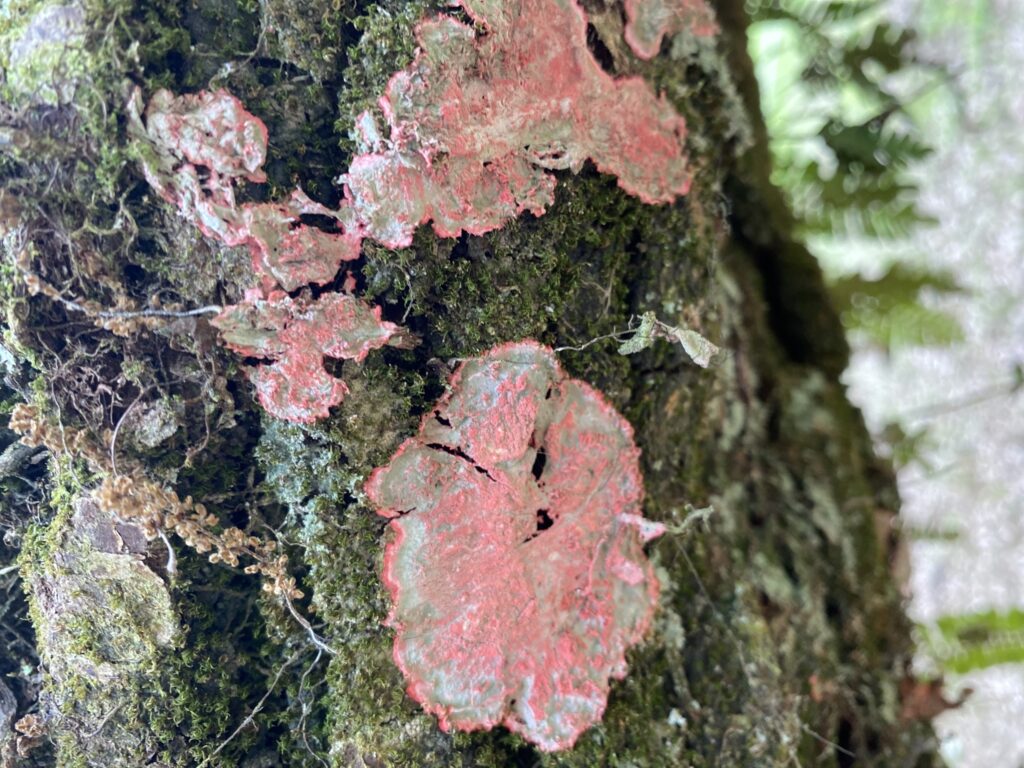
Christmas Lichen (Cryptothecia rubrocincta) growing on a branch in Bogue Chitto State Park. The red pigment (chiodectonic acid) offers protection from heat and sun. Photo by the author.
Lichen is an unusual sort of creature, more the emergent property of relationship than an individual or a species. Long believed to be composed of a photosynthesizing algal partner (the “phytobiont”) and a mineral-harvesting fungal partner (the “mycobiont”) it has long been held as an example of mutualism. The photosynthetic algae produces sugar which the fungus consumes, and in turn the fungus provides minerals and protection from desiccation. It’s an arrangement as straightforward and beautiful as a marriage. As usual, things are actually much more complicated than they would seem at first glance.
Much like human relationships, there’s never just two persons involved: my family, inlaws, friends, coworkers, and neighbors are also essential parts of my life. In the case of lichens, it has recently been discovered that yeast and bacteria are likewise indispensable. Christmas Lichen (Cryptothecia rubrocincta) growing on a branch in
Bogue Chitto State Park. The red pigment (chiodectonic acid) offers protection from heat and sun. Photo by the author.
This may explain why for decades scientists have failed to create lichen in labs even with ideal conditions and both phytobiont and mycobiont present. Lichen resists replication and scalability in ways that can be inspiring and educational.
Authored by Cam Russell
Sources
https://www.britannica.com/science/lichen
https://appvoices.org/2018/12/18/lichen-the-story-of-a-soil-maker/
https://www.purdue.edu/newsroom/archive/releases/2016/Q3/yeast-emerges-as-hidden-thirdpartner-
in-lichen-symbiosis.html
https://www.researchitaly.mur.gov.it/en/cultural-heritage-a-study-shows-that-leaves-andlichens-
can-help-preserve-archaeological-areas/