Using Key Clues to Identify Skinks Found in Louisiana Gardens and Yards
Last week I was talking with Beau, Louisiana Nursery’s Digital Media Manager, about what I should write about. He told me he had found a small nest with four eggs in his house and wondered what could have laid them. I was pretty sure it wasn’t a bird but reptiles aren’t really my wheelhouse. This struck me as a great opportunity to channel my inner Scooby-Doo fan, gather some clues and narrow down the possible suspects using my beloved Mystery Machine (my laptop) and crack the case.
Louisiana is home to so MANY species of reptiles (snakes, lizards, turtles, geckos, gators) it can be a little mind-boggling. I found 115 species identified on iNaturalist, a crowd-sourced nature identification-focused social media platform. Taking a deep dive into this very big and very old family revealed many surprises to me: snakes are a special kind of
lizard, alligators aren’t lizards at all, and all tortoises are turtles. Some reptiles species give live birth and even have a placenta similar to mammals, while some hatch eggs inside their bodies (called ovivipary), so I could rule those out as culprits. Many species lay eggs and then guard their nests, while some abandon them entirely and rely on location and planning
to keep their eggs safe.
Identifying wildlife by sight or sound is its own sort of mystery. Traces such as eggs, tracks, or scat offer their own clues and challenges. Signs will vary based on the season and many animals will alter their behavior to evade detection by humans. Some wildlife will avoid human habitation entirely if they can, while some have become adapted to close proximity with us and even thrive (see my article on Gulf Coast Toads for a great example). Knowing that Beau lives in a fairly developed area with a small yard (not an urban apartment or rural hunting camp) means we were likely dealing with one of the small lizards that frequent homes in our area: Anoles, Skinks, and Geckos being the main suspects.
Unmasking the Culprit
Suspect Number One: Green Anole
My first suspect is the native Green Anole (Anole carolinensis), the little green guy with the red throat fan you see doing his impressive little push-ups in the spring and summer. Abundant and rather comfortable living in developed areas, these insectivores are frequently fond of our sun-warmed bricks and wide green lawns. The breeding season occurs from May-October and females generally lay one or two eggs at a time. Eggs are abandoned in a secure location and left to incubate unsupervised, typically somewhere warmed by the sun. Incubation temperatures need to be between 80°F-85°F, a bit warmer than the average
house in November. While this was an unseasonably warm November, Anole breeding seasons are determined by photoperiod (hours of daylight), not temperatures. I crossed them off the list.

Source: https://www.drta-archiv.de/rotkehlanolis/
Suspect Number Two: Mediterranean House Gecko
My next suspect was the Mediterranean House Gecko (Hemidactylus turcicus), a small non-native lizard introduced to the US through the nursery trade (oops!) While not abundant, these little guys are an urbanized species who live comfortably in human dominated environments. That is, unless the humans happen to have cats. I find these poor little guys mangled in my home pretty regularly. They love hanging out on windows eating bugs attracted by our lights.
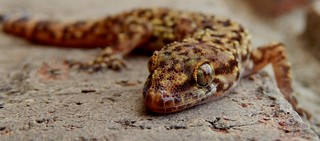
Source: hhttps://www.flickr.com/photos/69068522@N00/11503468863
House Geckos are best known for their distinctive chirping calls emitted when disputing with one another. In large aggregations these can become a nuisance. I’ll write more on these guys at a later date, but ruled them out for laying eggs in my friend’s house
because of their clutch size (1-2 eggs) and behavior (laying eggs from May to August). This left me with a small group of reptiles of interest.
Suspects Three, Four, & Five: Skinks
Skinks are special class of lizards, distinguished by their large, broad heads, reduced or absent neck, and ground-dwelling or burrowing habits. Scincidae is a large family comprising 1,275 species worldwide and can be found from the jungles of southeast Asia to the deserts of Australia to your Louisiana backyard. Skinks have a variety of adaptations to life on or under threat ground: eyes protected by transparent scales and some species have even lost their limbs entirely.
Louisiana is home to 5 species of Skink, three of which are found in East Baton Rouge Parish. These are: Common Five-Lined Skink (Plestiodon fasciatus), Broad-Headed Skink (Plestiodon laticeps) and Ground or Little Brown Skink (Scincella lateralis). These all resemble each other at different life stages and were through to be one species until the 1930s, so let’s dive a little deeper into what makes them unique.
The Broad-Headed Skink is the largest of Baton Rouge’s skinks, with adults measuring from 5.9 inches up to even a foot in length. They are also the most arboreal of our skinks, exhibiting a preference for Live Oaks with holes in them surrounded by brush. Dead and decaying wood and branches are important nest sites. Small groups called hibernacula will gather in and under decaying logs during the cooler months; flip over any branch or flowerpot this month and you may find some, but please don’t disturb them unnecessarily. Come spring they’ll eat your slugs and spiders voraciously.
When caught by a predator, these skinks will drop their tails (which will continue to wriggle!) In a process called autotomy. This will distract predators and give them the opportunity to flee, vertically if possible. When threatened, the skink will contract the
muscles around the spine to create a weakened zone between vertebrae called a fracture plane. If the threat persists, an enzyme called collagenase is released and breaks down the proteins of the tail to further weaken it. The skink then drops their tail voluntarily by whipping it back and forth until it snaps off. If the skink escapes and remains healthy, stem cells in the tail tip called blastemal cells regrow a new tail in a matter of weeks. While not painless, this is probably better than being eaten!

Broad-Headed Skink in my backyard, April 2023. Note the bifurcated tail, likely the result of an injury. The bright orange jawline indicates a healthy male ready to mate. Photo by the author
When a female Broad-Headed Skink is ready to mate, she emits pheromones from the base of her tail that attracts the larger males. Males will guard their mates from the attention of others, even sustaining injuries during the two-week breeding season. Females lay fairly large (8-22) clutches of eggs in nesting cavities. They sometimes pack debris down to form something of a nest and will guard their eggs until they hatch, usually in June or July. I’m ruling these out as possible offenders in the case of Beau’s Mystery Eggs. The lack of a nearby parent, while not conclusive, does suggest an abandoned nest.
A similar species is the American Five-Lined Skink, sometimes called the Blue-Tailed Skink for the bright blue tail it rocks as a juvenile, or the Red-Headed for the red head of the adults. These traits are shared with the Broad-Headed Skink, however. They can be differentiated from a distance by the size of the head (Five-Lined skinks have heads that aren’t much wider than their bodies) and from up close by their post-labial scales, which are significantly enlarged in Five-Lined Skinks.
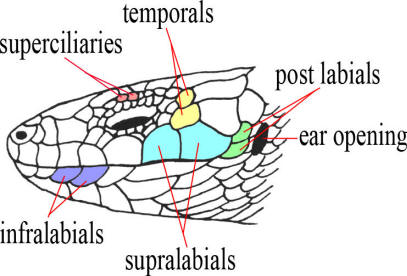
From the Virginia Herpetological Society. Next time you get up close try
finding these. Skinks may bite but have no teeth or venom.

Five-Lined Skink. Notice the enlarged postlabial scales (behind the ears)
Shot by Patrick Coin
The Five-Lined Skink is a bit smaller, measuring 4.9 to 8.5 inches as an adult, and has a more slender build than the Broad-Headed. Their namesake lines may fade as they age, as will the bright blue tail (although some females may retain it). These guys prefer the ground in moist areas with abundant hardwood trees and abundant basking sites to regulate their body temperatures.
Five-Lined Skinks lay their eggs in June, at the height of summer. They prefer to nest in secluded cavities in decaying logs, although I have found them under flowerpots. Areas of high moisture are preferred. They lay large clutches of 15-18 eggs and incubate them from 24-55 days depending on temperatures. Females brood their nests and defend them against small predators and remain with their hatchlings (called, incredibly, skinklets) for a couple of days after they hatch. They are attentive parents, coiling their bodies around the eggs to prevent moisture loss and transfer heat gained form basking in the sun. Eggs that are displaced are rolled back using their snouts, and rotten eggs are eaten to remove them from the nest and reclaim nutrients. The lack of moisture in most American homes and the emptiness of the nest, as well as the small clutch size, lead me to reject the Five-Lined Skink as a culprit.

Mama Five-Lined Skink brooding her eggs
Photo Credit John White
https://www.uniprot.org/taxonomy/463523
At the other end of the size spectrum is the Little Brown (or Ground) Skink, maxing out at 5.75 inches (the small range for Broad-Headed Skinks). These are one of the smallest reptiles found in North America. These lizards are fossorial, meaning they spend their lives in leaf litter on forest floors. Their long, slender bodies are perfectly adapted for slinking through leaf litter and mulch and their transparent lower eyelids keep their eyes protected without compromising their vision. They can be mistaken for small snakes at first glance, as they move with an undulating motion and their limbs are rather diminished. Females tend to be larger than males (as in most reptiles) but males have proportionally larger heads.

GUILTY
Ground Skink
Photo Credit: Patrick Feller
Source: https://www.flickr.com/photos/nakrnsm/3377109358
Ground Skinks are golden brown with lateral stripes running from head to tail. Their undersides are white or yellow. Their diets consist largely of small insects, spiders, and isopods. They do not possess venom or fangs, although they can detect prey using
chemical senses, flicking their tongues to detect prey. They are themselves the prey of many woodland hunters. Owls, snakes, even spiders and bluebirds have been observed eating Ground Skinks. They rely largely on their cryptic coloration and speed to remain hidden, with autotomy (tail-dropping) as a last line of defense.
Their eggs are laid from March to August in the Southern US, generally in clutches of 1-6. These clutches are much smaller than the others and occur later in the year. This fall having been unseasonably warm, it’s not impossible that they were still nesting in October or November. My Goldenrod is still blooming and my Sweetgum trees still have the majority of their leaves. In addition, these are small animals who don’t need a lot of room or prey to survive. In coastal areas, they can even become a nuisance. Skinks usually come into human homes through gaps in doors and walls in pursuit of warmth and bugs. If they find quiet, low-traffic areas, they may set up shop. While quiet and not smelly or biters, they can leave bits of shed skin, poop, and the occasional dropped tail around. They can also sometimes carry pathogens that, while unlikely to harm humans, can affect pets that just can’t resist catching and eating them. To prevent skink infestations remove water sources and use an irritating oil like peppermint, eucalyptus, or lemongrass around entry points. Enjoy them in your garden where they’ll control pests and aerate your leaf litter, improving the health of your plants. You can humanely relocate them with the old “cup and a piece of paper” trick if you find them indoors; they’ll be happier outside anyways.