It’s gray and muggy outside. The trees are dropping their leaves and the days are
somehow still getting shorter. The holiday gauntlet is ramping up as presents need to be
wrapped, cookies baked, and family gatherings planned. Walking my faithful dog around
the neighborhood always clears my head and lifts my spirits, so we hit the sidewalks. As
she sniffs the latest neighborhood gossip, I take a moment to watch a Cardinal sing on a
wire. He is a splash of color in the gloom, reflecting the meager sunlight and turning the
damp miserable air into his cheery birdy birdy birdy song, and I find myself smiling and
relaxing.
Few backyard critters are more beloved than the Cardinal, and it’s easy to see why!
With their bright colors and big personalities, these cheeky songsters liven up even the
grayest winter days. Conspicuous at feeders and along telephone wires year-round, the
Northern Cardinal (Cardinals cardinalis) is one of South Louisiana’s most celebrated and
recognizable birds. The Cardinal was the first ever designated State Bird, chosen by
Kentucky in 1926. Six other states (Illinois, Indiana, North Carolina, Ohio, Virginia, and West
Virginia) have since followed suit, and the Cardinal remains the most popular state bird in
the country, but as usual there’s more than meets the eye.
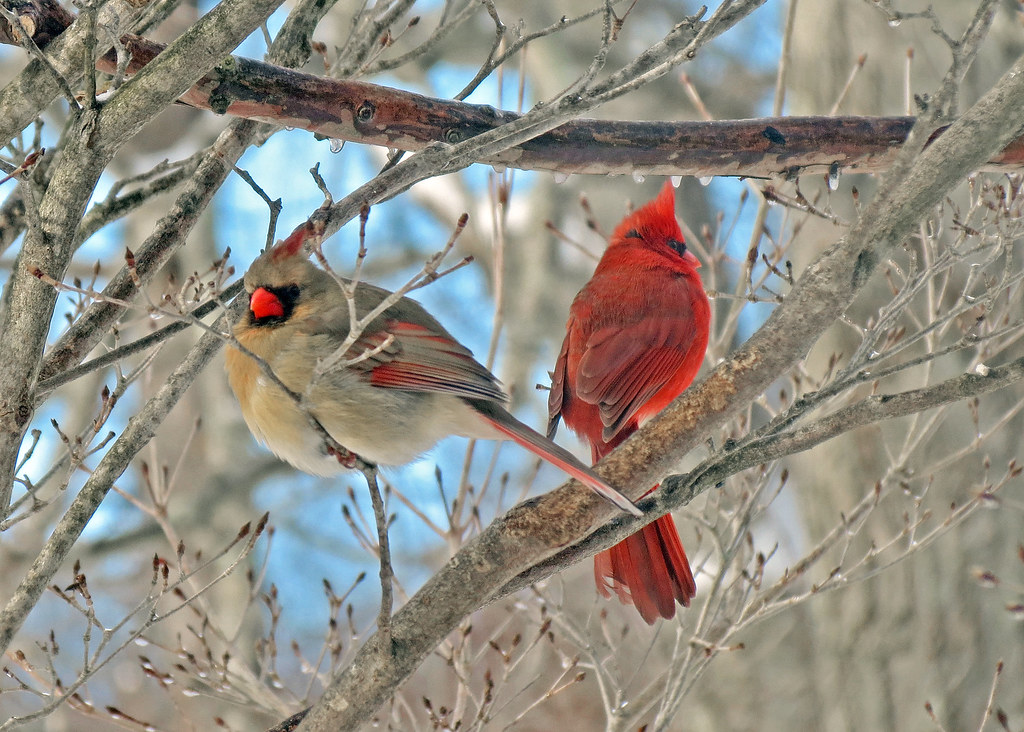
Female (L) and male (R) watching each other’s backs
Photo Credit James St. Johns
Why Louisiana Cardinals Stay Year-Round and How to Attract More to Your Yard
If you’re new to birdwatching and not looking to get your heart broken, Cardinals are a
great choice to begin attracting to your feeders. Cardinals are year-round residents in our
area, meaning that even in the dreariest winter days you can enjoy their beautiful plumage
and cheerful songs. Cardinals are granivorous, meaning they mostly eat seeds and nuts,
although they won’t say no to the occasional bit of fruit or insects. Try putting out black oil
sunflower or safflower seeds (available at Louisiana Nursery) to attract them. While their cute
round little bodies can make smaller feeders tricky to hang onto, I’ve seen them at my tube
feeders and also foraging around on the ground beneath. Having a fountain or pond nearby
is also a huge hit with all kinds of birds, especially if there’s been a freeze and you’re offering
liquid water.
Cardinals are a wonderful example of wildlife that thrives in modern American suburbs.
As temperatures warm, their range has expanded northwards. They readily come to feeders
and enjoy the seeds of garden selections such as Crape Myrtle (the most common tree in
Baton Rouge). It’s hard to believe that in 1926, less than a century ago, they were
considered “rare” by ornithologist Edward Howe Forbush!
Crest Friends
The Cardinal’s crest isn’t just for show: underneath is a patch of downy feathers that
trap heat. In hot summer months, they can raise this crest to release the heat and cool off. In
cooler temperatures, they fluff up their downy and lay their outer feathers to form a
waterproof, thermally-insulated shell. Their feathers form a natural sort of winter parka!
Like all birds, the condition of a cardinal’s feathers can be life or death. They need
healthy feathers for insulation, flight, and attracting mates. To keep themselves in tiptop
shape, they molt annually to replace their feathers with new, healthy ones. This molt typically
occurs in late summer, after raising their young so they can face the winter with a fresh set.
You may sometimes see bald Cardinals during this season! While alarming to look at, rest
assured that this is a normal and healthy process. Remember that all birds are after all a
kind of dinosaur!
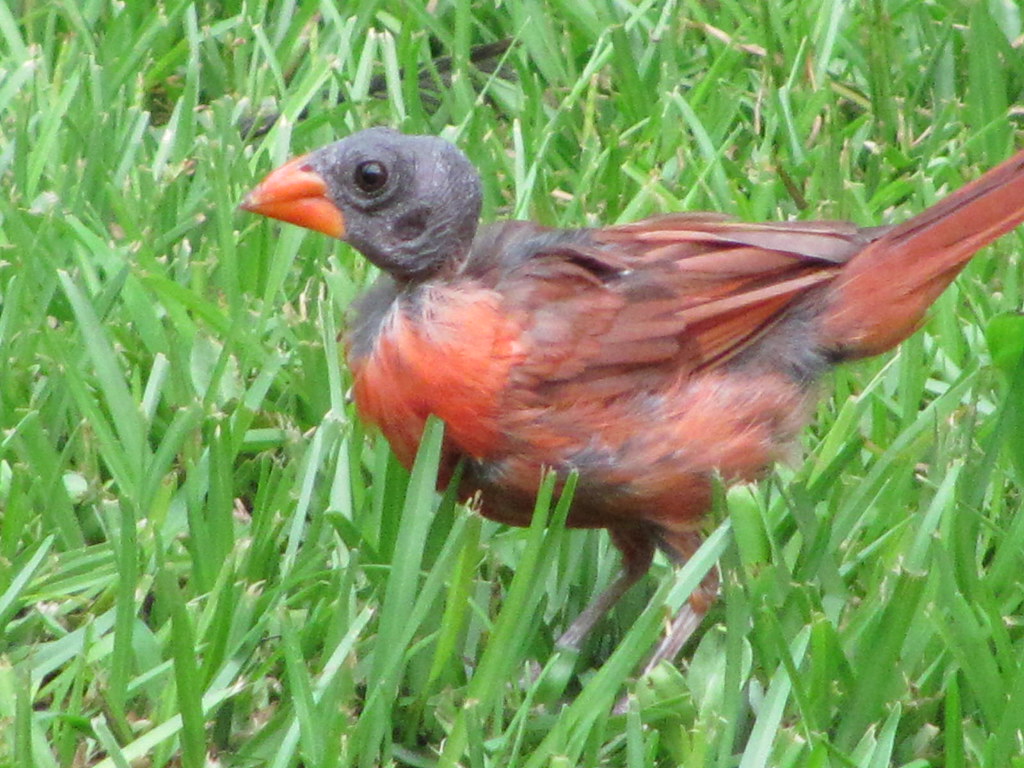
This Male Cardinal is taking advantage of the warm summer months to
replace his old, worn-out feathers.
Photo Credit: Geopungo on Flickr
https://www.flickr.com/photos/36319440@N05/7659127884/in/
pool-66139313@N00/
The male Cardinal’s iconic red plumage is the result of carotenoids found in their diet.
Interestingly enough, red is a rather popular choice for male birds for a variety of reasons.
While eye-catching, red can actually provide camouflage in dense tree cover. The Cardinal’s
feathers absorb other wavelengths and reflect red; when skulking in the undergrowth the red
wavelengths are absorbed by the green around them (green and red are visual opposites).
This can help the bright Cardinal go almost undetected. When it’s time to put on a show,
males will choose a conspicuous spot such as a bare branch or wire to best display their
colors as they sing. Male birds’ bright plumage signals their physical fitness in many ways.
Their ability to forage seeds and berries as well as a healthy metabolism will give them a
brighter color. Their capacity to avoid predators and danger while looking so bright and
colorful can also serve as an honest signal of physical agility and intelligence.
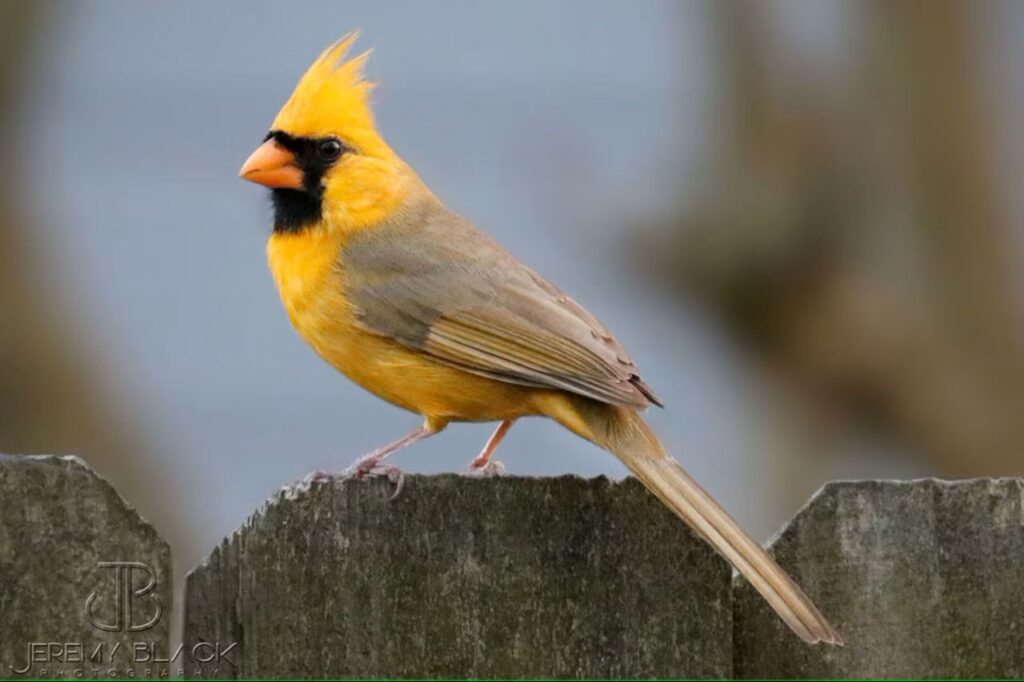
Since his debut, Maize the Cardinal has helped raise awareness of yellow
morph cardinals in the US and there have since been multiple confirmed
sightings throughout the Southeast. Keep an eye out!
Photo Credit Jeremy Black
Some cardinals carry a mutation that causes them to develop feathers in other colors
such as white or even yellow! “Maize” became a social media sensation in 2018 when he
was photographed by Jeremy Black. His unusual coloring doesn’t seem to hamper him with
the ladies, and he has been observed successfully rearing multiple broods of young.
Readers can follow his adventures on his Facebook page.
While often characterized as ‘drab,’ the female Cardinal’s plumage is no less beautiful.
Subtle shades of red, olive, and yellow blend seamlessly and disrupt the bird’s outline and
protect her and her nest. Careful observers can often learn to identify individuals at their
feeders by their unique markings.
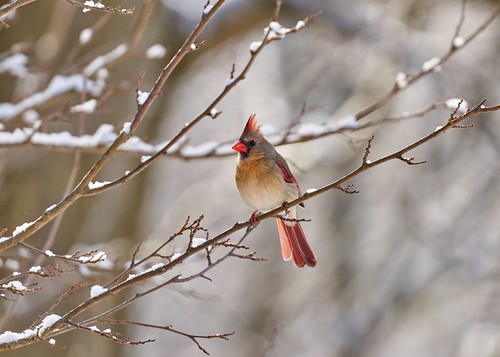
A gorgeous female keeps a watchful eye in a winter storm,
Photo Credit John Anes
https://www.flickr.com/photos/johnanes/49781152792/
Lovebirds
In Springtime it’s time to pair off, build a nest, ands raise young. Cardinal pairs often
get back together year after year, sometimes even mating for life. When one member of a
Cardinal pair dies, the other seems to go through an extended grieving phase; they’ll
withdraw to their nest, behave lethargically and sing less. Cardinals can live up to 12 years
in catviity, although in the wild it’s typically more like 2-7. When it’s time to win the affection
of their beloved, males have the adorable habit of bringing the females little treats during
courtship. They also bring small sticks which the female chews with her incredibly strong bill
until pliable, then she weaves into a cup-like nest. It’s almost like something out of Ozzie
and Harriet! However, much like 1950s America, there’s always drama lurking under the
surface.
Cardinals “divorce” fairly regularly, and often even get back together with their exes
after a season. After the breeding season is over, Cardinals hang out in flocks and socialize
with each other and don’t engage in pair behavior until the Spring. DNA testing on Cardinal
nests also reveal a certain amount of extramarital affairs; between 9% and 35% of Cardinal
young are fathered by someone other than the female’s primary partner. If male Cardinals
are aware of this, they seem to hold no grudges and nurture all of their partner’s young to
the best of their ability. After they leave the nest, young Cardinals are guided and fed by
their parents. They can be distinguished by their gray bills and sometimes by their habit of
begging next to feeders; if you see a gray-beaked Cardinal flapping its wings frantically on the ground and emitting a high-pitched Eeeeeeeeeep sound, you can be sure Mom and Dad
are nearby! As always, having abundant insect life in your yard (and keeping your cats
inside!) will ensure these beautiful and special creatures can continue to thrive and bring
Christmas cheer year after year.
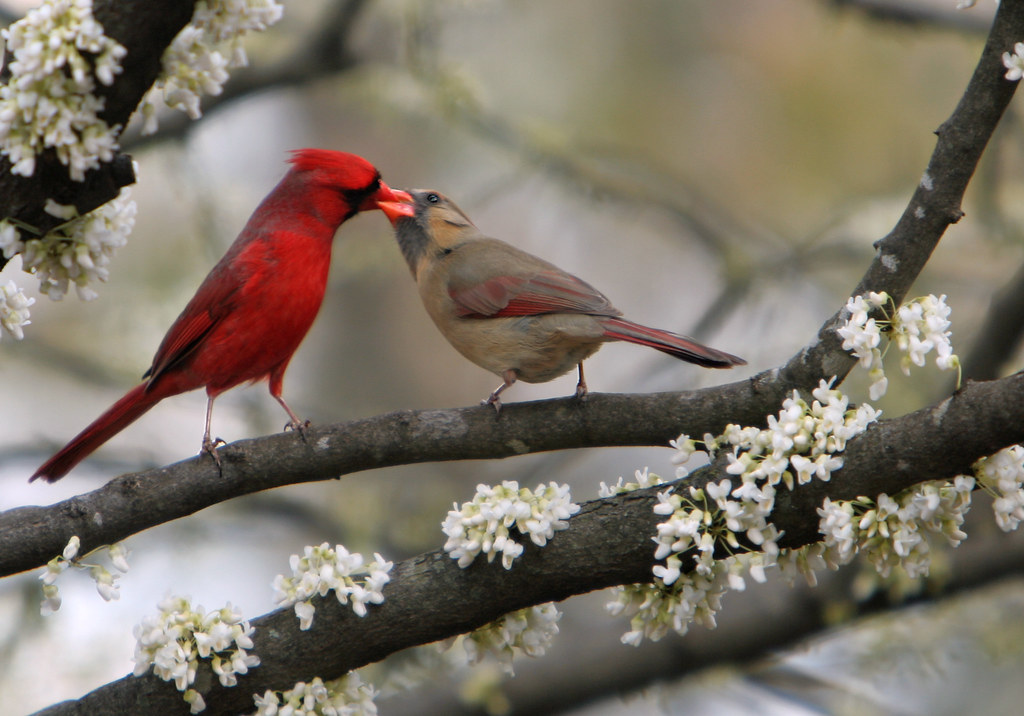
Male and Female enjoying a romantic dinner
Photo Credit Linda Yvonne
https://www.flickr.com/photos/from_linda_yvonne/2449770721/
Authored by Cam Russell
Sources
https://animalia.bio/northern-cardinal
https://www.allaboutbirds.org/guide/Northern_Cardinal/id
https://www.audubon.org/magazine/10-fun-facts-about-northern-cardinal
https://www.al.com/news/2021/03/alabamas-yellow-cardinal-the-science-behind-anamazing-
rare-bird.html
https://birdieexpert.com/bird-facts/do-cardinals-mate-for-life/