New Orleans is a city with many charms and attractions, but one of my personal favorites is the Besthoff Sculpture Garden. Located in City Park, the Garden is free to enter and open seven days a week.
The 11-acre garden is wheelchair accessible, and a winding path takes you through gorgeously landscaped water gardens lined with sculptures ranging from whimsical to monumental. Tucked underneath the majestic oaks, a colossal spider looms.
Giant spider sculpture located in Besthoff Sculpture Garden in City Park, New Orleans. By Louise Bourgeois.
Photo Source: https://noma.org/noma-named-best-museum-gambits-best-new-orleansreaders- poll/
This sculpture is one of several made by artist Louise Bourgeois starting in her late 80s that featured spiders.
Many were called Maman in honor of her late mother. Bourgeois explained why in her book, Ode à Ma Mère in 1995:
“[W]hy the spider? Because my best friend was my mother
and she was deliberate, clever, patient, soothing, reasonable,
dainty, subtle, indispensable, neat and useful as a spider.”
None of these words are often associated with spiders in the contemporary popular imagination. A spider in the home is often greeted with anything from humane removal with a cup to a violent shoe. However, spiders have been with humanity since day one and have much to teach those willing to learn.
Louisiana Spiders and What Their Silk Webs Reveal About Each Species
Some spiders have made a splash in the collective psyche, such as the helpful and literate Charlotte from the childhood classic Charlotte’s Web. “Charlotte A. Cavatica”, as she gives her full name, was a Barn Spider (Araneus cavaticus), a type of Orbweaver common throughout North America. Orbweavers are known for their distinctive webs that one finds strung across doorways and hiking trails, often by walking into them.
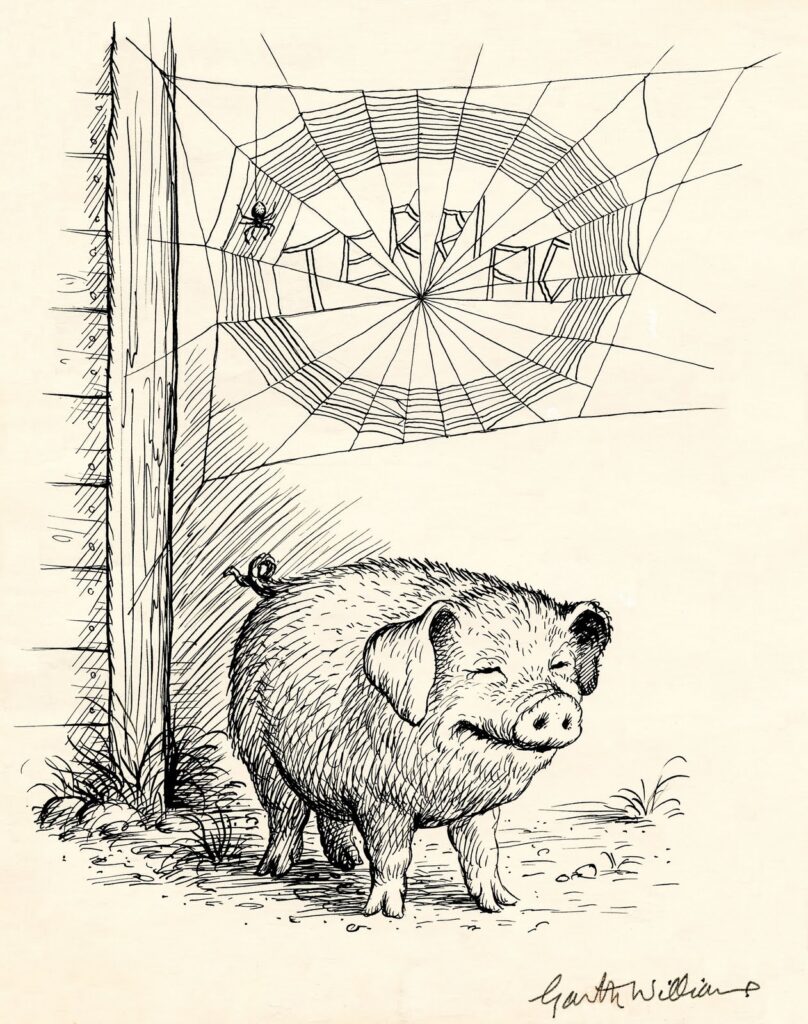
Image Source: https://bibliodyssey.blogspot.com/2010/12/charlottes-web.html
While all spiders produce silk, only some of them produce webs like Charlotte’s; spider silk is an incredible material that can be used for many purposes. Spider silk is made of proteins excreted from special glands on the spider’s abdomen. The shape of these glands determines the structure of the silk and its application. An orb web requires strong, thick fibers to anchor it as well as thin, sticky fibers for catching prey.
Some spiders build nests in tangles or funnels on the ground. South American Bolas Spiders don’t build webs at all, and use long strands of silk with sticky ends to lasso prey and wrap it up.
Diving Bell Spiders (found in Eurasia) use their silk to build “air tanks” from which they can breathe underwater as they hunt aquatic insect larvae. Fine strands of “balloon silk” are sent up by newly-hatched spiders to catch wind currents and disperse them to new territories.
Throughout history there have been attempts to make fabric with spider silk and to replicate it for mass production. In the 18th century, merchant François Xavier Bon created stockings and gloves made from spider egg cocoons.
The largest known piece of spider silk is a 4’x11’ cape produced under the direction of British art historian Simon Peers and the funding of Nicolas Godley. The project took four years of capturing Madagascar Golden Orb Spiders, mechanically “silking them” to harvest the silk, and returning them to the wild unharmed.
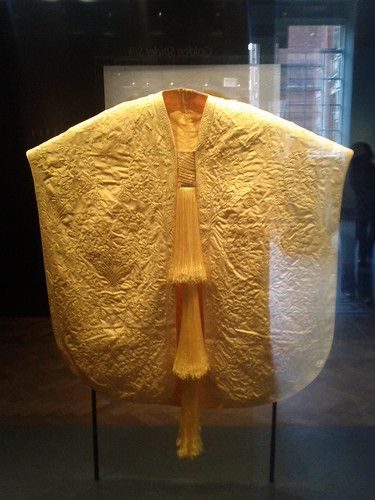
Photo credit: Ian Irving
https://www.flickr.com/photos/falsepositives/7205264826/
Their small size, fierce territoriality, and cannibalistic tendencies when stressed make spiders poor candidates for farming, so scientists have turned to other sources.
In 2010 researchers at the University of Wyoming announced they had successfully inserted silk-making genes into goats. These “spider-goats” are much easier to work with than spiders, having millennia of experience being kept by people, as well as producing much greater quantities of silk proteins in their milk.
It sounds crazy, but milk production and silk-making are biologically very similar processes in which proteins are synthesized and suspended in a liquid matrix. The hope is one day spider silk can be used for artificial ligaments and tendons, bone repair, bulletproof vests, perhaps even car airbags. Spiders have even gone to space!
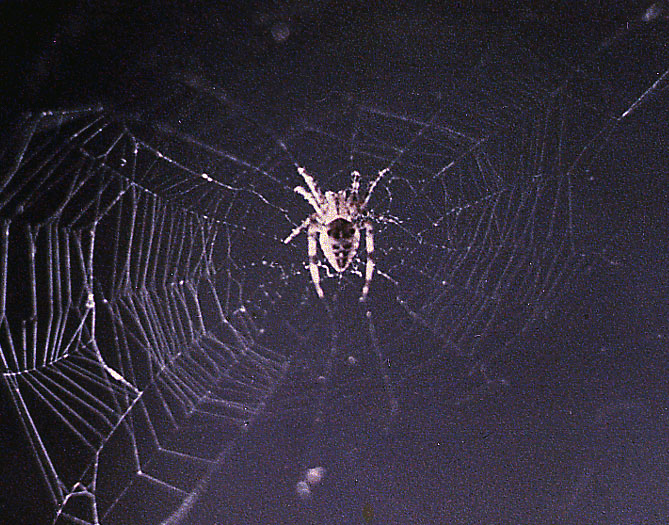
Photo taken by NASA astronauts of Arabella
In 1973, two female European garden spiders were named Arabella and Anita and taken to space aboard Skylab 3. Kept in a box resembling a window frame, the spiders were disoriented by zero-gravity at first.
Arabella’s first web was completed after a few days. Analysis of the webs showed they were very similar structures but the lines were of uneven thickness (webs built on Earth are usually very uniform) and were overall more fine. This could have been due to the lack of gravity or stress caused by the mission.
On Earth, spiders often eat their old webs to reclaim the proteins used, but on Skylab the webs were removed by astronauts to prompt the spiders to build again.
Spidey Senses
Photo Credit: emanuelkern
Photos Source: https://www.sciencealert.com/jumping-spiders-seem-to-have-aspecial-ability-only-seen-in-vertebrates
Spiders are well-known for having eight arms and eight eyes (although some can have six or even fewer)! Despite this abundance, many spiders have poor vision and, with some exceptions, rely more on chemical and vibrational cues to hunt and evade capture.
Spiders have different kinds of eyes, direct and indirect. Direct (or median) eyes are generally located in the front of the spider and capture more detailed images. The indirect eyes (located on the back and sides of the spider’s head) possess a reflective layer known as a tapetum that allows them to perceive motion and changes in light intensity.
The indirect eyes are crucial for nocturnal hunting and predator evasion. All eyes work in concert to provide the spider nearly 360 degrees of vision.
Jumping Spiders, however, have exceptional vision. Rather than weaving webs, they hunt by stalking and ambushing prey, and must be able to accurately gauge distance and identify likely targets to do so.
Their median eyes are very large relative to their bodies and have four types of cone cells, giving them tetrachromatic color vision. For comparison, humans only have three (although human tetrachromacy is suspected to exist among a small percentage of the population).
Studies performed with wild Menemerus semilimbatus jumping spiders seem to show that they can discern between animate and inanimate shapes mimicking their prey’s movements. For comparison, my dog (an 11-year-old Border Collie) can’t do this, and will bark her head off at even a picture of a squirrel.
Given that spiders lack ears entirely, it was long thought they couldn’t hear at all and instead relied entirely on sensing vibrations. In 2016 researchers studied Ogre-Faced Spiders, nocturnal hunters who capture prey by casting a net held between their four front legs.
They found that spiders have vibration-sensing hairs on their legs that can not only sense when a bug is flapping nearby, it can actually distinguish vibrational frequencies between insects, bird chirps, and bat echolocation. Not bad for someone without ears!
Fangs for the Memories
All spiders have venomous bites; their mouths and digestive tracts are too narrow for solid food and they do not have chewing mouthparts like insects do. Instead they have chelicerae (mobile appendages ending with fangs).
Some have long, thin fangs better-suited for tough exoskeletons, while some have short, thick ones for softer prey like caterpillars. Pedipalps and the labium help manipulate prey and guide it to the mouth.
Fangs can be used to deliver paralyzing venom or digestive enzymes that liquefy prey for ingestion. Growing up in the humid southeast I learned at a young age to avoid the Black Widows and Brown Recluses that hung out in the garden sheds and wooded lots I often explored.
There are approximately 30 species of Widows and 140 species of Recluses worldwide, which are capable of inflicting painful bites that require treatment.
Widow bites can cause redness, pain, and swelling which spread to your abdomen, chest, and back. Additionally, the toxin can cause abdominal muscle cramps, nausea, vomiting, tremors, or sweating. Recluse bites can cause pain that increases gradually for around 8 hours with flu-like symptoms (fever, chills and body aches) and necrosis of the wound.
According to the Mayo Clinic, spider bites are usually harmless and seldom occur without provocation. Mild redness, pain, and swelling are typical of any bug bite and many other skin conditions. Without witnessing the bite’s occurrence, it’s nearly impossible to tell if a spider or something else has bitten you.
Any break in the skin can become infected and problematic, and first aid disinfecting is always a good idea. If you have possibly been bitten by a dangerous spider, are experiencing severe pain or cramping, have difficulty breathing or swallowing, or notice the bite site has spreading redness or streaks, seek immediate medical help.
Spider fangs’ curved shape and structure makes them very strong, and scientists have been looking at mimicking the design for better injection needles. Additionally, a protein called Hi1a has been synthesized from Australian Funnel Web Spider venom.
This protein is being tested as a possible tool to reverse damage from heart attacks and possibly protect hearts for transplant from cellular damage that occurs during transport to new patients. Phase I (animal test) trials show promise, but it will take years of research to ascertain if this will be helpful or practical for human patients. All the more reason to keep an eye on these spellbinding creatures.
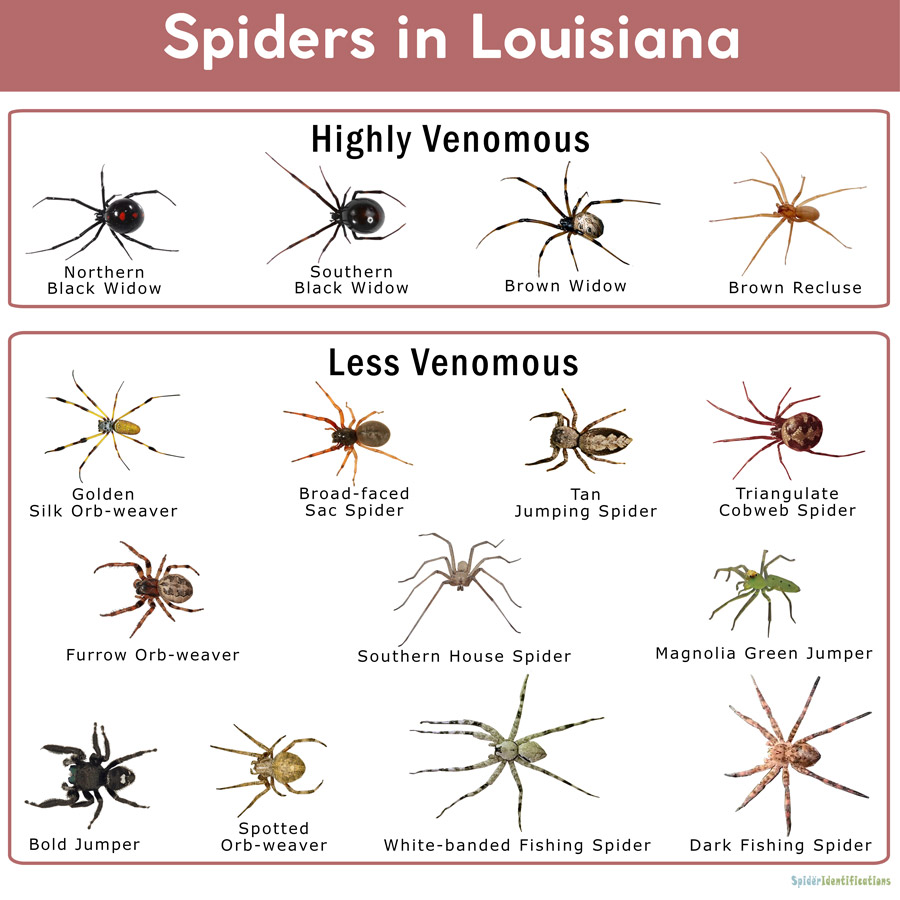
Some common Louisiana spiders
Tying Up
Loose Ends
Spiders are here to stay. These incredible, adaptable creatures can set up shop pretty much anywhere with oxygen. Like all predators, they play an important role in managing populations of prey animals, many of which are annoying to gardeners: thrips, aphids, roaches, mites, mosquitos, leaf miners, caterpillars, and so on.
While they will munch on any insect that comes into their web, including desirable ones like bees and wasps (wasps are critical pollinators), the presence of spiders in your garden means any one species of insect is far less likely to overrun and upset the ecosystem you’ve poured your sweat and tears into building.
Spiders overwinter in your garden and fall debris and emerge with other insects, giving you a head start on pest control that requires no effort on your part. Whether it’s the showy orb webs strung across your window or the delicate frothy dome webs glittering in the morning dew in your grass, there’s a spider for your pest.
Next time you see a spider crawling somewhere, instead of reaching for a shoe, maybe take a moment to identify it. I personally like to use iNaturalist, a free photo identifier app for iPhone or Android. The best thing about it is that, while initial suggestions are made by a computer, there is a driving community of naturalists who will analyze and identify your picture and offer ID suggestions.
Uploaded images can also be surveyed by a global community of scientists and amateur naturalists alike who can help you narrow down what you see and how to tell. It’s easy and free to use and has been a great help to me in getting familiar with many of the strange and marvelous creatures with whom I share my home.
Authored by Cam Russell
Sources:
https://www.cnn.com/style/article/louise-bourgeois-spiders/index.html
https://arachnidanswers.com/what-do-spiders-see/
https://ownyardlife.com/41-spiders-in-louisiana-pictures-and-identification/
https://en.wikipedia.org/wiki/Spider_silk
https://sciencing.com/spiders-mate-4595717.html
https://www.mayoclinic.org/diseases-conditions/spider-bites/symptoms-causes/syc-20352371
https://www.gardeningchannel.com/garden-spiders-good-or-bad/
https://spideridentifications.com/spiders-in-us/spiders-in-louisiana
https://www.sciencealert.com/jumping-spiders-seem-to-have-a-special-ability-only-seen-invertebrates
https://www.science.org/content/article/these-frightening-ogre-faced-spiders-use-their-legshear
https://spidersusa.com/a-comprehensive-anatomy-of-spider-mouth-parts/
https://www.livescience.com/45888-spider-fangs-are-natural-needles.html