Hummingbirds:
Priceless Jewels of the Garden
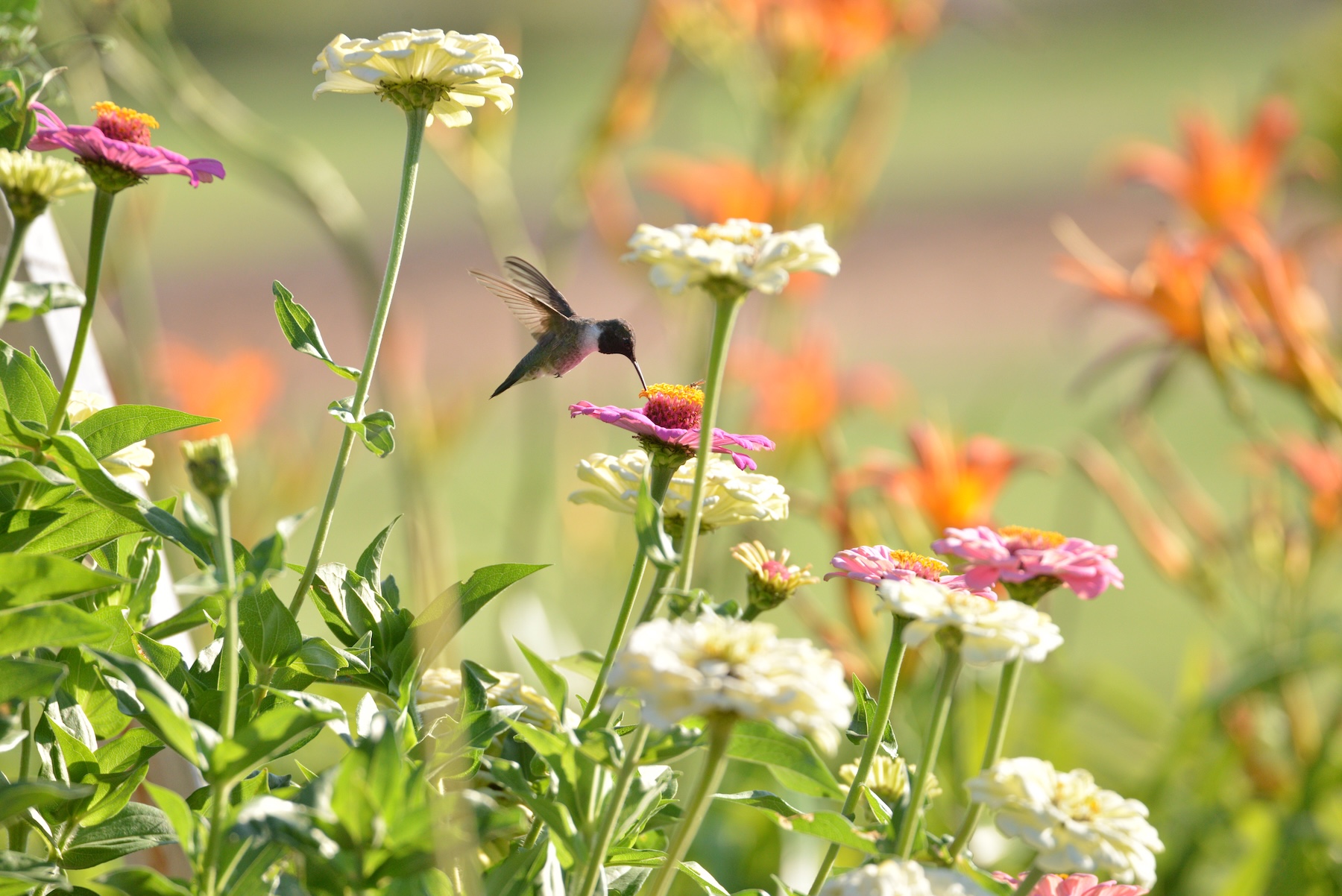
Birdwatching can be habit-forming. If I’m near a window or outside, my eyes automatically scan for movement or color, latching onto passing butterflies and falling leaves alike. Like many birders, I am hopelessly addicted to hummingbirds. Their gem-like colors and acrobatic flight can be hypnotic. The way they seem to float in mid-air, their wings beating so fast (80 times per second!) that they blur into invisibility. They seem almost alien at times, hovering and flying backwards like little spacecraft, but the hummingbird is perfectly and absolutely a creature of our one-of-a-kind planet. Louisiana is fortunate to play host to several species of Hummingbirds, and at Louisiana Nursery we have what you need to turn your garden into an oasis for these wayfarers!
The Best Nectar Sources for Attracting Hummingbirds in Louisiana
Hummingbirds have incredibly high energy demands due to their active lifestyles. Even at rest, their hearts beat around 250 bpm (two and a half times the resting heart rate of a healthy adult human). When in flight or chasing other birds, it can go as high as 1,260 bpm!
This means they need food that provides a lot of energy in a small package, and nectar is a perfect source. Energy from sugar is available to the body quickly with minimal digestion, as anyone who has chugged a Coke can tell you. A 4 gram hummingbird needs 40-60 calories per day, meaning they need to drink a LOT of nectar (1.5-2 times their body weight)!
Hummingbird nectar can be easily made in your kitchen. In a small pan, heat 4 parts water with 1 part granulated sugar (eg., 1/4 cup sugar and 1 cup water) and stir until the sugar dissolves. Only plain granulated sugar should be used; low-calorie sweeteners will not give the hummingbirds the energy they need and some varieties can be toxic. Nectar will keep in a sealed container in the fridge for up to two weeks. For the busy hummingbird lover, pre-made nectar is available in liquid or powder forms at all Louisiana Nursery locations!
Feeders should be checked daily and cleaned regularly. Sugar water spoils quickly in Louisiana heat and can harbor mold or even ferment and produce alcohol, which is toxic to hummingbirds. You can use hot water and dish soap or a dilute solution of bleach (1 part bleach to 9 parts water) or diluted distilled white vinegar (1 part vinegar to 2 parts water). Ports can be scrubbed with special brushes such the ones used with reusable straws or a spoolie (clean mascara wand sold at cosmetic supply stores). All feeders should be rinsed thoroughly and allowed to air dry before refilling.
If that sounds like a lot of work, consider planting some nectar powerhouses! They’ll beautify your yard and attract hummingbirds while also cleaning and refilling themselves!
Below are some great options for Louisiana gardeners that we carry at the nursery:
- Honeysuckle
- Abutilon
- Turk’s Cap
- Salvia
- Bottlebrush
- Trumpet Vine
- Mandevilla
- Dipladenia
- Hibiscus
- Shrimp Plant
- Firebush
- Pentas
- Lantana
While red is the color classically associated with hummingbirds and a definite eye-catcher, don’t be afraid to experiment! Red light has a long wavelength and can be perceived at greater distances, but blues and purples are some of the rarest colors in nature and can also be very attractive to nectar-drinkers. Plant a variety of plants with overlapping bloom times to keep the party going.
Where the Humming Things Are: Feeder Placement
Okay so your feeder is clean and filled and you’re ready to watch some hummingbirds! You’ve been hearing their tell-tale chittering and maybe even seeing them around, but none seem to be coming where you can see them. For the first spring in my house, I had planted Lantana and Pentas in the flowerbed next to my driveway, but no takers!
There are many factors that separate a forlorn feast for flies from a hummingbird hot spot. Find a spot where the feeder is visible to passing birds (but not too exposed),easily observed (but not too close to a window), and high enough to be safe from predators (but not too high to clean and change) can be tricky! Below are some things to consider when locating prime real estate for your guests.
Cover
Part of the charm of the hummingbird is how tiny they are. It’s easy for humans to forget what sort of hurdle a few feet present to someone the size of your thumb! My driveway was easy to see, but there was nowhere quiet to go when things got busy. Nearby evergreen shrubs and trees can provide cover year-round (you heard me. More on that later).
While your feeders should be visible from many angles, they should be within a couple of feet of some sort of cover for hummers to retreat to. Nearby shrubs or flowers can offer a valuable safe haven but watch out! When placed too near plants, sometimes guests such as Praying Mantises may invite themselves to the party. These can stress out and sometimes even kill hummingbirds that venture close. Shoot for a distance of one to three feet from plantings. Feeders should also be sheltered from rain and afternoon sun (morning sun is fine).
Height
Hummingbirds prefer to feed 3 ft – 6 ft from the ground. Too low and they risk ground predators such as snakes and cats, and too high up you’re spilling nectar every time you refill (spillage also entices other sugar junkies like bees, wasps, and squirrels). A shepherd’s hook with a hanging basket of impatiens was my first successful foray into attracting hummingbirds. Small plants can also be elevated using stools, plant stands, or stumps.
Windows
Collisions with windows kill an estimated 1 Billion birds a year; many of these deaths are easily prevented. Researchers all over the country (including at our own LSU) have surveyed a variety of buildings and structures to determine what makes windows so dangerous.
If a bird does strike your window, you may gently capture it and take it to a licensed wildlife rehabilitator in your area. To minimize stress on the bird, gently cup your hands or a towel over it and transfer it to a box. Avoid feeding or watering, as more interaction will further stress the bird. Window strikes are often fatal, and even birds who fly away later succumb to brain injuries. Fortunately, many strikes are preventable.
In daylight, reflections of the surrounding landscape confuse birds who expect to be dodging branches or soaring through clouds. After dark, when many birds migrate, windows that are lit from the inside seem to disappear Curtains, blinds, decals, UV-reflecting gel (which comes in a tube like a chalk marker), and other accessories can warn and deter birds. Good old-fashioned insect screens can also prevent collisions. Turning off lights in unoccupied rooms and buildings at night not only helps birds, it reduces light pollution and saves energy.
For best results, markers should be spaced 2” apart and preferably on the outside of the glass for maximum visibility. “Wind Curtains” are an elegant option as well. These are essentially strands of weather-resistant paracord that are hung outside of windows to alert birds to the presence of an obstacle.
This is not a sponsored or affiliate link, but curtains can either be ordered or made using instructions available here.
Balanced Diet
Nectar is only part of hummingbird diets, however. Insects are a crucial source of protein and minerals the hummingbird needs to build muscle, replace worn-out feathers, and lay eggs. For this reason, insects are the basis of any healthy terrestrial ecosystem. Unfortunately, insect biomass has decreased by nearly 75% since 1970, threatening to collapse the for web for both wildlife and people. On the bright side, every yard can support some insect life. This fall, consider leaving the leaves or making a brush pile in your yard for overwintering wildlife. Selecting native plants such as Turk’s Cap or Salvia will not only provide your hummers with a food source that cleans and refills itself but will provide insect food at crucial times.
Little Bird, Long Haul
Ruby-Throated Hummingbirds are the only species of hummingbird that breed in Louisiana, being mostly present from March-October. After they’re done raising their young for the year, they depart from our shores and fly over the Gulf of Mexico (in a single night!) to their wintering grounds in Central and South America. They need to double their weight to survive the journey, and fall is when we see the most frequent and spectacular numbers of hummingbirds. You can generally take your feeders down in October, but that doesn’t mean the fun has to stop.
It wouldn't be louisiana without a little lagniappe
Louisiana also plays host to “winter hummingbirds,” that is: any species other than a Ruby-Throated (or a Ruby-Throated that comes between November 15 – February 15). Cooler temps mean less frequent cleaning of feeders will be necessary but they should still be checked and cleaned at least once a week. Frozen nectar should be replaced as well. Plants such as Turk’s Cap, Salvia, Cuphea (“cigar plants”), Porterweed, and Shrimp Plants produce nectar in the absence of freezes and are wonderful additions to a winter garden. Below are some of our winter hummers.
Anna’s Hummingbirds (Calypte Anna)
Photo Credit: LeRoy Van Hee
Black-chinned Hummingbird (Archilochus alexandri)
Photo Credit: James Badger
Broad-billed Hummingbird (Cynanthus latirostris)
Photo Credit: Heather Paul
Allen’s Hummingbird (Selasphorus sasin)
Photo Credit: Becky Matsubara
Calliope Hummingbird (Selasphorus calliope)
Photo Credit: Jim Sedgwick
Broad-tailed Hummingbird (Selasphorus platycerus)
Photo Credit: Greg Schechter
Buff-bellied Hummingbird (Amazilia yucatanensis)
Photo Credit: Brandon Trentler
Rufus Hummingbird (Selasphorus rufus)
Photo Credit: Tim Dickey
Researchers with the Audubon Society are trying to learn more about what brings winter hummers to our area and what they need to thrive. If you or someone you know spot any winter hummingbirds, you can join them!
Email your observations to Dr. Erik Johnson (erik.johnson@audubon.org) with the following information:
- Your name
- Your city/town
- First observed (FO) date (or, if discovered while banding or marking other birds, the date it was observed)
- Species (please send photos, if available, for confirmation)
- Age (Adult, immature, unknown)
- Sex (Male, female, unknown)
- Whether banded, when and by whom
Like all birds, hummingbirds are the descendants of dinosaurs that survived the five mass extinctions our planet has experienced. A sixth mass extinction currently underway threatens many of them; out of 366 species known globally, approximately 21 are threatened. Many hummingbirds live in remote and mountainous areas and are adapted specially to certain plants and blooming times, making population surveys tricky. In addition, their small size and delicacy means that typical bird-banding techniques must be modified and banders must undergo additional specialized training.
Banding birds is a practice in which they are caught, examined, and fitted with a metal leg ring with a unique identifying code. If the birds are caught or found in the future, scientist can obtain valuable information about age, health, or migration routes. Hummingbirds are caught in specialty cages set up around feeders. If you’re lucky, sometimes you can even hold one in your hand to release it!
As summer winds to a close and we get ready for winter, be sure to keep your eyes open for surprise guests this year!
Authored by Cam Russell