New Year’s has long been one of my favorite holidays. It’s a chance to reassess choices made in the last year and to decide what direction I wish to direct myself. After the holiday chaos, New Year’s is a day you can celebrate with as much or as little spirit as you
have to spare. It finds us balanced between bacchanal and catharsis, standing in a room made unrecognizable by new gifts and probably more than a few scattered cold-weather clothes. This is the time of year when we begin to pack and tidy up, finish off the leftovers and begin building our daily routine back. Such cleaning up is a necessary part of any healthy habitat.
Fortunately, we have a powerful partnership of remarkable critters offering us a bird’s eye view of the mess: Louisiana’s two species of vultures, the Black Vulture (Coragyps stratus) and the Turkey Vulture (Cathartes aura). The scientific name of the Turkey Vulture, Cathartes aura, can be translated as “cleansing wind.” As I pack back up my Christmas ornaments, I find myself wishing for one of those! While often associated with filth and decay, vultures are in fact one of humanity’s allies in keeping the world clean and livable. Much like the people who clean our toilets, collect our trash, and wash our hospital linens, the noble vulture is an unsung hero to whom we owe much.
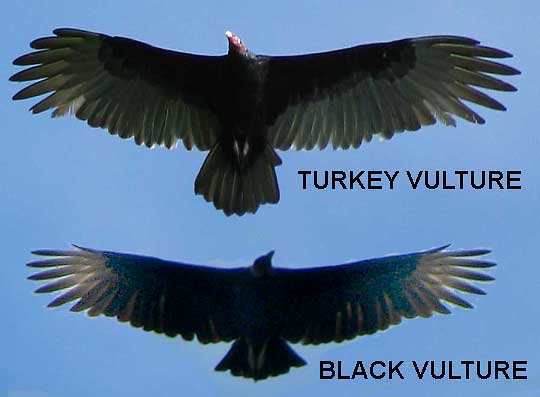
Jim Conrad created this image to compare the two vultures we find in
Louisiana. The two species often work in concert to find food.
Why Louisiana Vultures Soar at Such Great Heights and What They Are Doing
Vultures may be the highest-flying birds on Earth. On November 9, 1973, pilots cruising at 37,000 feet over West Africa struck what turned out to be an endangered Rüppell’s Vulture the plane landed safely, although the bird did not survive the encounter). This strike was not able for the extreme altitude at which it occurred: most birds fly at heights of 500-2,000 feet.
Whether you’re cruising down I-10 or getting the mail, you’ll probably spot some vultures making long, slow circles across the winter sky. They are often riding rising columns of warm air called the thermals. Their broad wings catch the air and lift them, allowing them to soar great distances in search of food while expending almost no effort. Vulture’s respiratory systems are also specially adapted to life at altitude, allowing them to remain alert in the thin air.
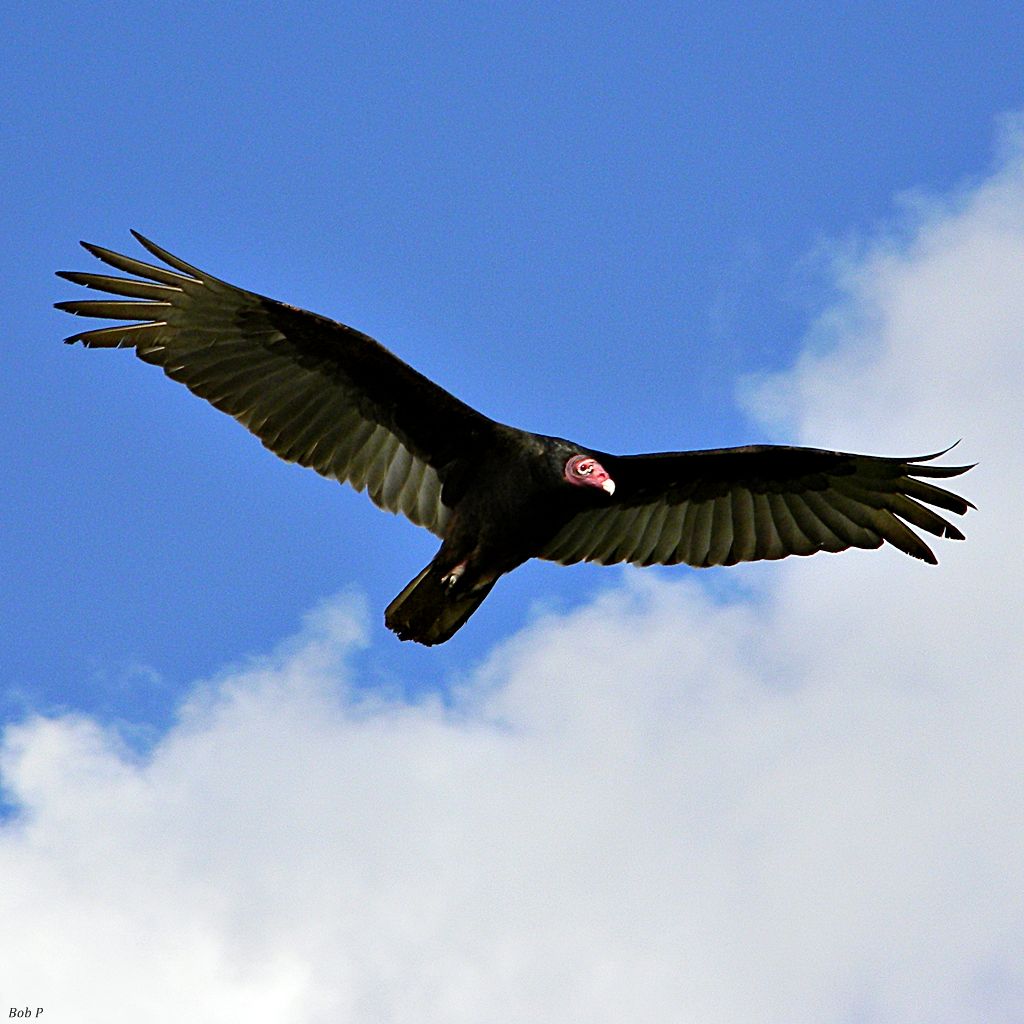
The Turkey Vulture’s flight is effortlessly graceful
Photo by Bob Peterson
https://www.flickr.com/photos/pondapple/12715999235/
The unique tetrahedral (V-shaped) flying posture of Turkey Vultures is self-stabilizing: one wing rises higher than the other, air spills out from underneath it and the bird levels off. What they lack in speed or agility they make up for in sheer efficiency. High in the atmosphere, the air is less dense and has less oxygen than what we breathe on the ground. The less dense air provides less lift for flying birds, and many species struggle to compensate with extra flapping. Vultures however, are masters of the art, taking advantage of decreased drag to fly even faster. This allows Turkey Vultures to travel as far as 200 miles in a day in their search for food.
Another distinguishing feature between vultures and many other birds is that most of them have excellent senses of smell. In 1938, Union Oil began injecting gas lines with a smelly chemical called mercaptan to assist humans in detecting leaks of the odorless gases. Unfortunately, this only works when a human is within sniffing range of the leak and required constant monitoring of miles of pipeline. Vultures, however, respond to mercaptan (it’s chemically similar to products of decay) and began circling near leaks, allowing monitors to spot issues from a distance.
This ability to sniff out very diluted concentrations miles up in the air is due to one of the largest olfactory bulbs (relative to brain size) of any animal. While open country scavengers like the Black Vulture rely on keen eyesight, the Turkey Vulture can sniff out prey under dense tree cover or even in ditches and culverts. These remarkable abilities have allowed them to become one of the most widespread birds on the planet.
Clean Eating
Vultures are not many people’s favorite birds. They lack the syrinx that allows songbirds to delight us, and instead communicate in grunts, hisses, and squawks. Their presence at various carcasses and association with death and decay can inspire fear and
disgust. In preparation for this article, more than one person asked me if they needed to worry about vultures killing their beloved pets (they don’t). Turkey Vultures are not raptors, being more closely related to storks. They lack the strong feet and sharp talons required to kill their own prey, although their bills are sharp enough to pierce tough hides. If Fido unfortunately ends up as roadkill they will do their best to clean him up. While this image may horrify, it’s important to remember that without their service, we would be quite literally in deep doo-doo.
In the late 1990s and early 2000s, India’s vultures experienced a 99% decrease in their population, an unintended side effect of consuming dead cattle treated with diclofenac (an NSAID that proved toxic to the vultures). As vulture numbers plummeted, carcasses accumulated and were instead eaten by rats and wild dogs, whose populations exploded.
While vultures are not the only scavengers in the games: they don’t spread certain pathogens such as anthrax and rabies. Vultures have a unique microbiome, coupled with high body temperatures and extremely acidic guts that allows them to safely eat rotten meat and remove such pathogens from the ecosystem entirely. The Indian Vulture Crisis resulted in an estimated 38.5 million extra dog bites and an additional 47,300 deaths from rabies in India between the years of 1992 and 2006. Diligent conservation efforts are underway and diclofenac has been banned for veterinary use. However, Vultures are very long-lived and captive breeding will take decades to bring back pre-crisis numbers
In the United States, vultures are protected by federal law and are widespread and common, seen across North and South America. While they face obstacles such as ingesting lead from shot or habitat loss, they remain steadfastly soaring over the continent. Next time you spot some in the distance, elegantly dancing on the wind, stop and offer your respects to someone who does the dirty work so we don’t have to.
Authored by Cam Russell
For Further Reading
https://www.backyardnature.net/n/08/081006.htm
https://www.nationalgeographic.com/animals/birds/facts/vultures
https://www.livescience.com/48899-vultures-bacteria-microbiome.html
https://www.earth.com/news/how-vultures-fly-faster-in-thin-air-at-high-altitudes/
https://www.chattnaturecenter.org/visit/experience/wildlife/animal-facts/turkey-vulture/
https://www.forbes.com/sites/scotttravers/2024/08/18/the-highest-flying-bird-was-found-atenth-
of-the-way-to-space/
https://india.mongabay.com/2018/02/declining-vulture-population-can-cause-a-health-crisis/