
Moles in Louisiana: How Deep They Dig and the Damage They Leave Behind
The pine needles are crunching underfoot as my mom and I weave through Mt. Zion Cemetery on a clear January day. We are photographing tombstones for Find-A-Grave, a database used by amateur historians and genealogists like my mother. She takes a special interest in rural, undocumented cemeteries and I am, as always, more than happy to get outside and walk around. The sky is achingly blue and the Jays and Cardinals are gossiping up a storm in the trees. The graves are edged with long raised lines of softened earth, indicating a healthy population of moles, likely the Eastern Mole (Scalopus aquaticus).
On the whole, Moles are generally out of sight, out of mind for most people. They live almost their entire lives below ground, emerging only rarely when driven by predators or sudden flooding (the Eastern Mole is actually a rather skilled swimmer, hence the specific epithet aquaticus). In 2021, my wife saw a wild mole for the first time in her life among the roots of a Live Oak in our neighborhood. We were on one of our daily walks with the dog, who called our attention to the thumb-sized creature before it disappeared quickly into the ground, likely never to be seen again by human eyes.
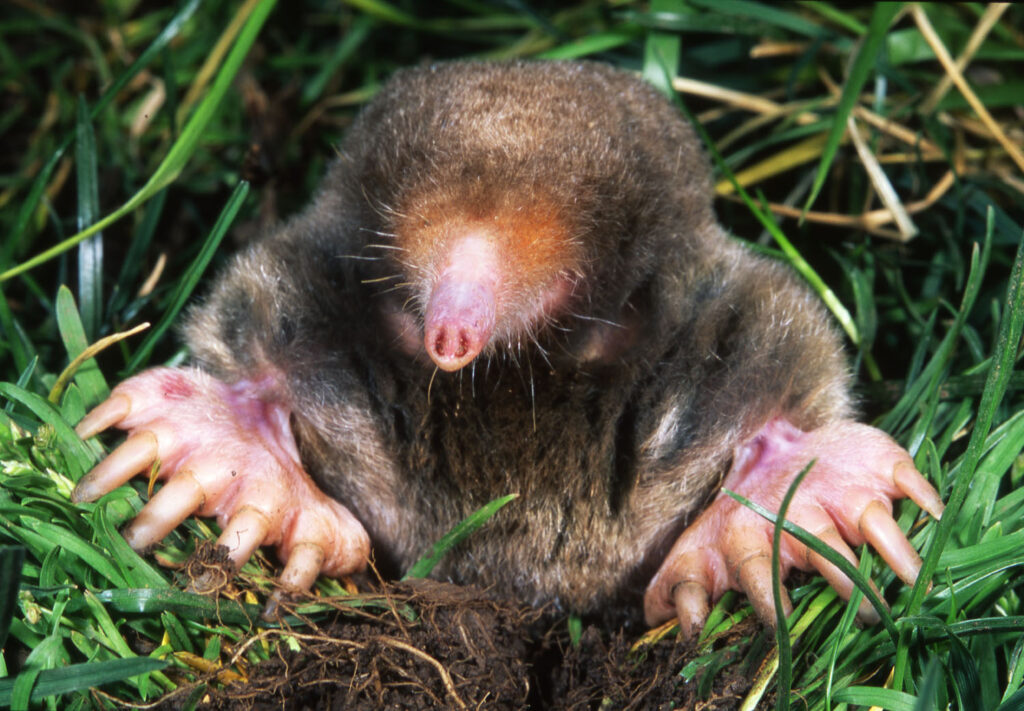
Eastern Mole
Photo by Kenneth Catania
The Hole Truth
Typically, most people only encounter moles in the form of the long ridged tunnels or soft earthen hills they sometimes leave in yards and gardens particularly along the edges of hardscape such as driveways and pavers. If you think about it, it’s not that strange that they would circle the concrete vaults of human graves. While many may balk at the comparison, moles are amateur historians in their own right, sometimes digging up priceless artifacts for us to study. In England, the second-century Roman fortress Epiacum has been closed to human excavation by law; however, moles play by their own rules and excavate some 60 feet of tunnels a day. While forbidden to dig, (human) volunteers examine what the moles bring up in annual molehill surveys and have discovered artifacts believed to date back to Roman times such as beads and pottery.

Archaeologist Dr. Jan Harding explaining how he teams up with local moles to excavate an ancient fort
These temporary surface tunnels are not in fact the permanent homes of moles but an ingenious trap for the mole’s preferred foods: burrowing insects like grubs and earthworms. All that digging is energetically costly and moles must eat every few hours to keep themselves alive. Moles are almost entirely blind and deaf, relying on vibrations and smell to navigate their world. When the insects breach the walls of the tunnel and fall in, moles sense the vibration caused by the worm’s fall and race to catch it. The mole’s prey is paralyzed with a venomous bite and stored (still living) in special larder holes deep within the earth. Excavations have found as many as 470 earthworms in a single mole pantry. Moles produce a special toxin that paralyzes their prey to keep them fresh in storage; when it’s time to eat, they’ll use their broad, spade-shaped paws to squeeze dirt and grit out of the worms. Delicious!

Surface feeding tunnels and hills of displaced dirt are likely the only sign of mole activity most people will see.
Earthbound and Down
Moles have developed many interesting adaptations to their fossorial lifestyle. Reduced ears and eyes are protected from dirt by soft, velvety fur with a unique texture. The short, stiff fibers are tough but soft and can be readily brushed in any direction, allowing moles to easily turn around in tight spaces. The color name taupe is derived from the French noun for this animal, and its supple leather was especially prized for gloves and other articles of clothing, particularly in the 19th century when Queen Alexandra of Denmark started a craze for moleskin garments. Mole trapping briefly went from a marginal subsistence activity to a lucrative trade in Scotland.
While the idea of life underground seems like the stuff of horrors to most humans, moles have adapted to breathe easily in oxygen-depleted environments thanks to specialized hemoglobin, the protein in mammal blood that carries oxygen throughout the body.
Researchers are looking to this special hemoglobin to develop artificial blood substitutes to ameliorate shortages in the blood supply.
Moles have also developed a style of walking that is truly unique among mammals. Rather than position their limbs beneath their bodies, moles hold their front limbs out from their bodies like fins, dragging themselves along using their extra thumbs as they loosen the earth, kicking it behind them. Their odd, sprawling gait protects their tunnels from collapsing behind them; rather than lifting and setting down knees and elbows, they effectively “swim” through the soil. Moles can move up to 32 times their own weight, making them an unsung keystone species in many terrestrial ecosystems.

Diagram of proposed burrowing robot inspired by the mole. Designed by Tao Zhang et al
The mole’s perfect adaptation to the Earth does not mean it’s stuck here. Scientists are looking to the mole’s burrowing technique for inspiration for planetary soil exploration. NASA’s InSight mission to Mars included a heat probe nicknamed the “mole,” designed without a standard drill that would have required a bulkier motor. Unfortunately, the Martian soil lacked the friction of our planet and the “mole” was unable to dig more than a few inches deep.
Moles are found pretty much anywhere on Earth, on every continent except Antarctica and South America. While gardeners may detest their hills and burrows, their presence actually indicates a healthy soil ecosystem in your yard! An urban legend holds that moles eat plant roots, but they are generally carnivorous and prefer juicy insect prey. While too-vigorous digging can damage fragile new plantings, moles provide valuable services in aerating soils and controlling the population of grubs (who, incidentally, do eat plant roots). The graveyard in Alabama we visited is home to some of the continent’s oldest and most oxidized soils, the famous red clay. The presence of moles allow water and nutrients to percolate downward and churn up the soil, softening it for plant roots to work their way through and establish themselves. Without moles, you’re left with impermeable hardpan and increased runoff, flash floods, and poor tilth. While feeding tunnels and molehills may be unsightly, they can be easily tapped down without damaging the soil. Typically you will see these tunnels only seasonally, when the water table has risen underground to bring the moles closer to the surface. Next time you’re walking around and see a mole run, stop and say thank you to one of Nature’s hardest-working soil engineers.
Authored by Cam Russell
Sources
https://animalia.bio/eastern-mole?custom_list=1346
https://www.bbc.co.uk/news/uk-england-cumbria-22363936
https://www.vtcng.com/thecitizenvt/community/outdoors/winter-larder-moles-shrewsare-
underrated-tunnelers/article_e1f20248-6f29-11ec-b611-1335ec7c4e91.html
https://www.truthaboutfur.com/moleskin-unique-fur-favoured-by-high-society/https://
www.science.org/content/article/moles-have-one-most-unusual-walks-earth