
Wigging Out!
Earwig Fact & Fiction
While gumbo may know no season, there’s something about a simmering soup in the fall; the way it invites you to stand still for an afternoon, knowing you’ll have something delicious at hand for the rest of the week. National Gumbo Day is coming up (October 12)!
I’m standing in my kitchen chopping vegetables, watching the hummingbirds at my feeders and listening to Red, Taylor Swift’s most autumnal album. The scraps of celery and bell pepper will go (with some shredded mail) to my earthworms. The worms live in a bin next to my kitchen trash and turn my leftovers into beautiful compost for my garden. I lift the bin’s lid and to my surprise something flies out! I yelp, startled, but when it comes to rest I see a familiar insect: an earwig.
Earwigs are perhaps one of the creepiest of crawlies: they scamper in the dirt, fleeing light and hiding in damp cracks and crevices. Their long segmented bodies move in an almost sinuous way, and don’t even get me started on those weird little pincers!
Like many people, I was told they got their name from a tendency to crawl into people’s ears, eat their brains, and/or lay eggs. Until recently I didn’t even know they could fly, although their scientific name Dermaptera (“skin wings”) offers a clue (Note: this is not to be confused with Dermoptera, which means the same but refers to bats).
Being a curious person by nature, I embarked on a quest to learn the truth about these weird little guys who live in my house as my soup simmered away peacefully.
Louisiana Earwigs: Lending an Ear to a Misunderstood Garden Critter
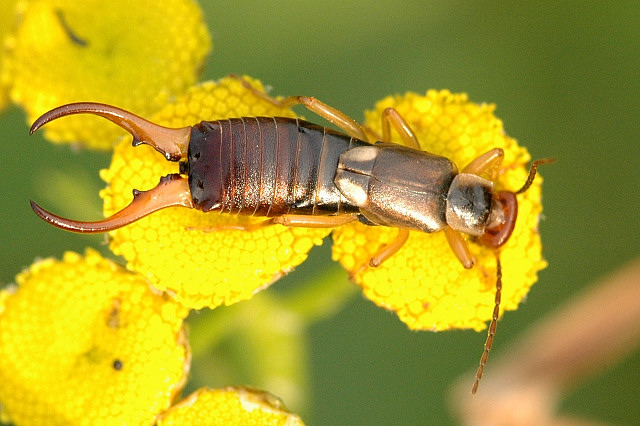
There are 10 native species of earwigs in the United States, but the one most people will encounter in their homes is the introduced European (or Common) Earwig Forficularia auricularia. Both sexes have pincers, called cerci, at the ends of their abdomens. These are more curved in males and are used for mating displays and hunting.
Myths of earwigs crawling into people’s ear canals have persisted for millennia. The specific epithet auricularia, meaning “ear-like,” actually refers to the shape of the earwig’s unfolded wings, which I’m sure many will find a relief.

(Photo Credit: Dr. Jakob Faber, ETH Zurich)
There may be a grain of truth to such tales. Earwigs respond to touch, a trait called thigmotaxis that helps them crawl into small spaces where they huddle for warmth and protection.
Earwigs get most of their energy from decaying plant matter, and in historic times when people slept on mattresses of hay and straw, it’s not impossible that the occasional earwig crawled by mistake into someone’s ear, but they certainly cannot chew through the eardrum or human skull into the brain. Otologists do frequently pull insects out of people’s ears, but cockroaches are by far the most common, likely due to their sheer prevalence in human habitations.
Earwigs mostly live in leaf litter, under rocks, or in crevices between bark. They prefer habitats cooler and less moist than the native clay soils of much of south Louisiana, but air-conditioned homes with well-mulched gardens outside can be very attractive to them. Adults may overwinter on south-facing slopes or in flower stems outside. Indoors they may hide in pantries or compost bins such as mine.
Something Wigged This Way Comes?
This time of year, earwigs are beginning to pair off and start their families. While not truly social (in the way ants and bees are), earwigs do cooperate to survive. Earwigs release an aggregation pheromone that encouraged them to gather in suitable habitats and hunker down. While this sometimes results in masses of earwigs in places we’d rather not see them, it’s a brilliant survival strategy that has allowed earwigs to succeed globally.
Earwigs have uniquely elaborate courtship rituals, with the males dancing and using their cerci to attract willing females— notably, the cerci are never used against other earwigs to fight or copulate. Males with their cerci removed experimentally have never been shown to successfully find a mate. Male and female pairs will nest together in fall, the female lays one or two clutches of around 50 eggs.
The earwig is a hardworking, dedicated single mom. She continually cleans fungal spores and other pathogens from her eggs and defends them from predators. She can tell the difference between her eggs and fakes such as small balls of wax and will remove them, although she will care for other earwig eggs as her own if they are added to her nest. She will stay in her nest throughout the winter with her mate, although he will depart before the eggs hatch in the spring.
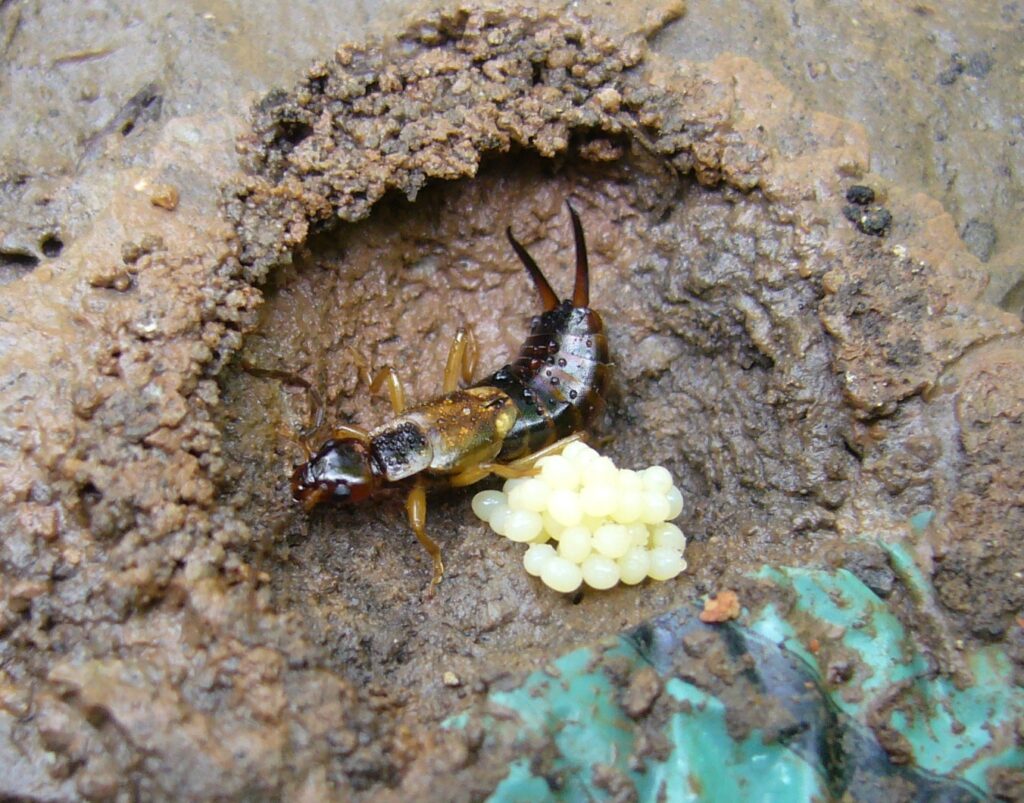
(Mother earwig guarding her nest. Photo by Tom Oates, 2010)
When it’s time for the eggs to hatch, she arranges them in a single layer. Earwigs are hemimetabolous, meaning they hatch looking like small, wingless versions of their adult selves called nymphs. They will stay in the nest with their mother and she will provide them with food until they go through their first molt. She will then lead her young on nightly foraging expeditions until they go through their second molt. Such one-on-one maternal care is almost entirely unique in insects.
Leaf: It's What's For Dinner!
When earwigs do become pests, it’s typically in early spring when the year’s nymphs have entered their free-foraging phase and insect prey is still scarce. Earwigs will eat silk from ears of corn (another possible source of their name), as well as rotting or damaged fruit. While no earwig-specific insecticides exist, some broad-spectrum ones such as diatomaceous earth and Diazinon, a persistent organophosphate, have been used successfully. Biocontrol using parasitoid wasps has been attempted with mixed results.
Earwigs eat plant matter mainly because it’s what’s available. However, when insect prey is available they will eat with gusto, with aphids being a particularly favored prey. Apple orchards with high earwig populations have much lower levels of wooly apple aphids, a major pest. Integrated pest management means balancing risk and making informed decisions about pesticide use.
Winging It
Earwigs have another unique trait: those spectacular wings. They tuck neatly under protective leathery coverings called elytra while burrowing or crawling through tight spaces, but can expand nearly 18 times their folded size! Not only is this the highest folding ratio in the animal kingdom, they can hold their wings open while expending virtually zero energy! This is made possible by a protein called resilin that is held under strain, snapping the wings open at a moment’s notice. Below is an illustration by Jakob Faber:

Scientists have attempted to replicate this feat using 3D printing and multiple materials to create structures that fold and pack themselves. The hope is that this technology can one day be used for something as simple as collapsible tents or as complex as self-deploying solar sails on spacecraft. While the humble earwig and I may prefer to stay close to the ground, it may help us explore the universe in its own small way.
As summer winds to a close and my gumbo comes together, I gently set the earwig back into my compost bin. I appreciate a little better the complexity and beauty of the small lives all around me, and count myself lucky to know her a little better. I hope we can help each other have a nice cozy winter.
Authored by Cam Russell
)