Preparing for winter looks different for different people. For the squirrels, it means
running across my roof all night, stuffing extra leaves into their dreys for extra insulation.
Aquatic animals go to deeper waters, reptiles slow down the metabolisms, and trees drop their
leaves and shut off sap flow. For my family, our recent surprise snowstorm meant wrapping
pipes and stocking up on books, puzzles, and most importantly, lots of birdseed. I have never
been a big fan of the cold but watching the birds flutter around my yard was not only
entertaining, it gave me a feeling that all the work I’ve put into re-wilding my suburban yard is
paying off. The squirrels made use of the Sweetgum leaves I left on the ground this past fall,
and the stands of Goldenrod gone to seed in my backyard draw one of my favorite winter
visitors: a little bronze confetti of a bird called the American Goldfinch (Spinus tristis).
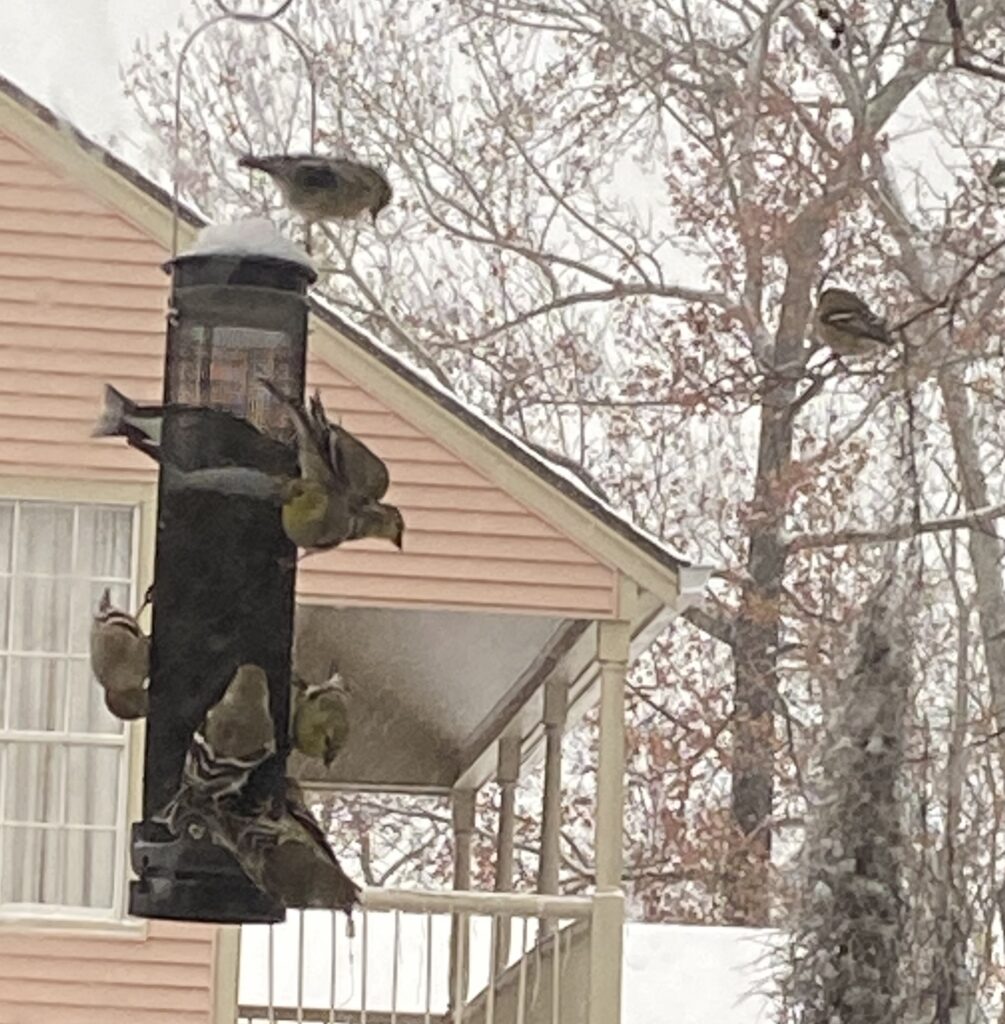
Goldfinches travel in large flocks in the winter, often with other birds such as Pine
Siskins and Purple Finches. Here is a small portion of the flock that passed
through my yard. (Photo by the author)
Golden Year
Goldfinches get their name from the vibrant, lemony color of the plumage they wear
during spring and summer further north. By the time they come South for the winter, they are a
a metallic shade that to my eyes mimics gold much more closely. They travel in loose flocks
with other winter finches, and can be distinguished by their dark wings (brown in females and
black in males) with two white bars and white edging on the flight feathers. Their tails also
have a distinctive notch at the end. As they forage for seeds, they communicate constantly
with each other in musical warbles and trills. Their cheerful chirps and constant motion bring
life to a winter garden and keep me (and my cats) enthralled during the dreariest part of the
year. I frankly should have written this article during our snow days but was too enchanted
watching them and refilling my feeders.
Goldfinches are exclusively granivorous, meaning their diet consists almost entirely of
seeds. While most passerine songbirds rely on insects during the breeding seasons of spring
and summer, Goldfinches remain steadfast seed eaters year-round. This is possibly an
adaptation to deal with nest parasitism by the Brown Cowbird, the young of which are reared
by unsuspecting songbird parents of other species.
Goldfinches are adapted perfectly to what John James Audubon called “wantoning on
the wildflowers.” Their feet are very nimble and sensitive, allowing them to hang upside-down
from flowers, removing seeds or even holding them down. In his seminal Birds of America,
Audubon relays how they use their agile limbs and cunning to escape a sticky situation:
There is a trait of sagacity in this bird which is quite remarkable, and worthy of the notice
of such naturalists as are fond of contrasting instinct with reason. When a Goldfinch
alights on a twig imbued with bird-lime expressly for the purpose of securing it, it no
sooner discovers the nature of the treacherous substance, than it throws itself
backwards, with closed wings, and hangs in this position until the bird-lime has run out
in the form of a slender thread considerably below the twig, when feeling a certain
degree of security, it beats its wings and flies off, with a resolution, doubtless, never to
alight in such a place again; as I have observed Goldfinches that had escaped from me
in this manner, when about to alight on any twig, whether smeared with bird-lime or not,
flutter over it, as if to assure themselves of its being safe for them to perch upon it.
Gardening for wildlife is a year-round activity (or sometimes, non-activity). During the
Spring and Summer, towering Goldenrod and Ironweed wave their majestic purple and gold
flowers like flags in the wind. Glittering hordes of native pollinators like sawflies and groundnesting
bees sparkle on the blooms throughout the long hot Louisiana summers in a
mesmerizing display. When the flowers go to seed and the pollinators pass on, it’s tempting to
cut them down and move on the next exciting thing (in my yard, it’s hummingbird season).
However, leaving the flower heads standing offers a big reward in the fall and winter: passing
migrating songbirds are drawn to the abundance of seeds in my yard and insects hiding in the
stems. Sources of liquid water at various heights and a variety of shrubs to retreat to make my
yard an oasis in Mid-City Baton Rouge for nearly 60 different species of birds. Not bad for a
third of an acre!
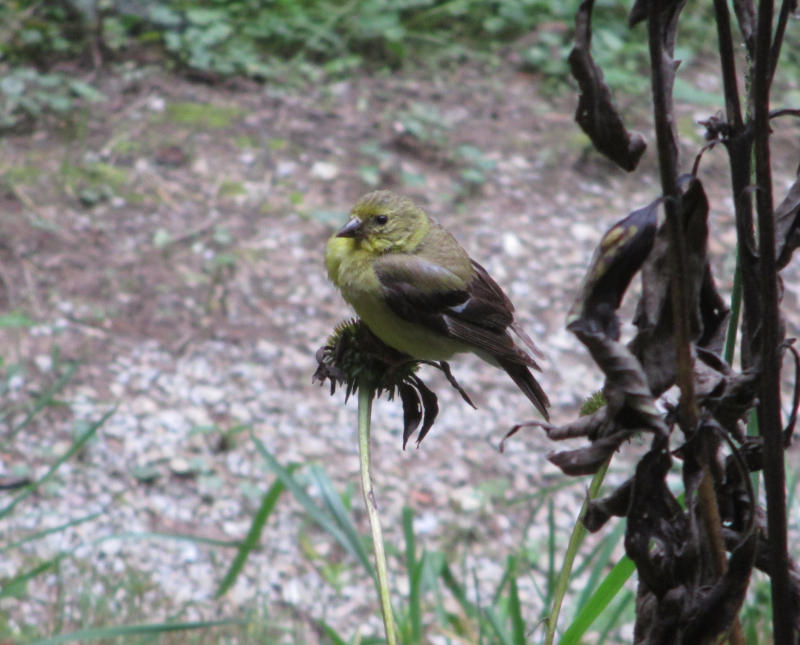
Female Goldfinch on Echinacea seedhead left by a thoughtful gardener.
Photo Credit Cathy Bird
I’m the first to admit that my laissez-faire approach isn’t for everyone. My yard looks
wild and it’s full of bugs (which I don’t mind). If you (or your partner or roommate or dog or
HOA) aren’t quite ready to take the leap, there’s still lots you can do to make your yard more
bird-friendly and enjoy the show.
Let’s Get Thistle-cal
You may have seen in our stores something called a thistle sock, or noticed the bags of
tiny black seeds branded as Nyjer (and wondered why they were so expensive). These are a
special kind of seed, not of true thistle but of an African wildflower Guizotia abyssinica, also
called noog, ramtilla or blackseed. It’s grown in Northern Africa and parts of India not just for
use as birdseed, but is also pressed for its oil which can be used for cooking, lighting, and
soap-making.
Guizotia was first imported and branded to the United States as “thistle” to capitalize
on its similarity to the Goldfinch’s favorite North American wildflower (It is only distantly
related). The seed is extremely rich (30%-40%) in oil, on par with black oil sunflower but much
easier to eat for small winter seed-eaters like Goldfinches. Its thick hull lets it keep for up to a
year, but the high oil content does mean after opening it’s best kept in your freezer or
refrigerator. No worries, my goldfinches have demolished most of the bag I purchased in the
last few weeks!
Guizotia was branded as Nyjer by the Wild Bird Feeding Institute in 1998, to avoid
confusion with true thistle and also with the original name of Niger (pronounced like the
country). It is the only birdseed we use that is grown almost exclusively outside of the United
States, contributing to the comparatively high cost. Another factor contributing to the high
cost is the need to sterilize imported seeds by heating them to 120 °C (248 °F) for 15 minutes.
This process kills off undesirables hitchhikers such as dodder but does not affect the quality.
In 2002 a variety called EarlyBird was patented and approved by the USDA and are being
grown as after-season crops in the United States, lowering prices somewhat.
If you’ve been feeling the winter blues, come on down to our stores and treat yourself to
something new. I personally can’t imagine trudging through January and February without my
Goldfinches. Planting options and days are limited and unwrapping and re-wrapping my
hosepipes to water is a pain, but the birds offer a low-maintenance way to add color,
movement, and music to the gray days.
Authored by Cam Russell
Sources
https://www.audubon.org/birds-of-america/american-goldfinch
https://www.audubon.org/news/whats-deal-nyjer
https://www.denverpost.com/2014/04/29/gardening-for-birds-leave-seedheads-on-to-lurewild-
finches/
https://www.nwf.org/en/Magazines/National-Wildlife/2024/Winter/Gardening/Winter-Garden