

If you’ve read a few of my previous articles you’d know that I’m a sucker for innovative farming and horticultural techniques. No other industry has shaped the direction of society over the past 100 years more than agriculture, and new technologies are always forcing us to reimagine what is or could one day be possible. Most new patents in the space take on the issue of food scarcity by increasing the amount of food that can be produced on a set amount of land. It’s what has made fresh foods last longer, and food costs to decrease. There is, however, a problem that we aren’t as aware of in the first world, and it has little to do with not being able to produce enough food. Rather, its about the “where” and “when”.
As we know all too well in Louisiana, natural disasters such as flooding can leave people stranded without food for a dangerous amount of time. This problem is even worse in less developed areas of the world, who’s lack of building regulations and food production infrastructure create a deadly combination when weather strikes. That’s where this amazing new concept, the “floating farm” came into play originally. There are quite a few companies in the space now, but originally was used to prove that new land did not have to be cleared in order to produce high quality food. One such floating farm in Norway actually powered the entire vessel using solar panels and was able to fit 40 milk cows on board! It’s relatively small scale, but the concept has potential to be used in so many different situations. Using clean energy to power the vessel will decrease the heavy reliance we see today on fossil fuels across the industry. Using bodies of water that are currently vacant decreases the need to destroy natural environments for land.
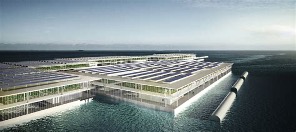
Usually that would be enough to sell me on the idea, but one article on the subject explained the lack of fresh foods in developing countries can also be partially solved through the floating farm initiatives. Put simply, many countries do not have the roads, bridges, or ports to make fresh foods a viable option for the impoverished populations. If floating farms were set up in water ways closer to the citizens themselves, they could eat fresher, healthier foods at fractions of the current cost. Charities around the world have started investing in these projects because they see potential in disaster relief. No other system could be up, running, and producing healthy foods as fast as these farms. It can take years to rebuild a country’s farming sector, and in that meantime, floating farms could be the only option.
Hope you all found this interesting as I did!